
Claude has evolved into a multimodal AI capable of handling text, images, charts, and more. Here’s a quick breakdown of its key versions and their standout features:
- Claude 3 Haiku: Fast, affordable, and efficient with a focus on visual data processing. Ideal for tasks like content moderation and customer support ($0.25 input/$1.25 output per million tokens).
- Claude 3 Sonnet: Balanced reasoning and speed. Handles complex data like technical manuals and excels in multilingual tasks ($3.00 input/$15.00 output per million tokens).
- Claude 3.5 Sonnet: Introduced advanced OCR and "Computer Use" for interacting with interfaces. Great for DevSecOps and automated workflows.
- Claude 4 Sonnet: Combines quick responses with deep reasoning. Handles large-scale tasks, like processing 1M tokens, and scores highly on coding and math benchmarks ($3.00 input/$15.00 output per million tokens).
- Claude 4 Opus: Anthropic’s most advanced model, optimized for complex tasks like R&D and autonomous agents. Features extended reasoning and tool integration at $5.00 input/$25.00 output per million tokens.
Quick Comparison:
| Model | Strengths | Limitations | Best Use Case | Pricing (Input/Output) |
|---|---|---|---|---|
| Claude 3 Haiku | Fast, low-cost visual processing | Limited reasoning depth | Content moderation, data extraction | $0.25 / $1.25 |
| Claude 3 Sonnet | Balanced speed and intelligence | Superseded by newer versions | Sales automation, retrieval | $3.00 / $15.00 |
| Claude 3.5 | Advanced OCR, UI interaction | Moderate cost | Automated workflows, coding | $3.00 / $15.00 |
| Claude 4 Sonnet | Large-scale tasks, high accuracy | No image generation | Coding, complex instructions | $3.00 / $15.00 |
| Claude 4 Opus | Top-tier reasoning, tool use | Higher cost | R&D, autonomous agents | $5.00 / $25.00 |
Each model serves specific needs, from low-cost processing to advanced reasoning for enterprise tasks. Choose based on your priorities: speed, cost, or complexity.
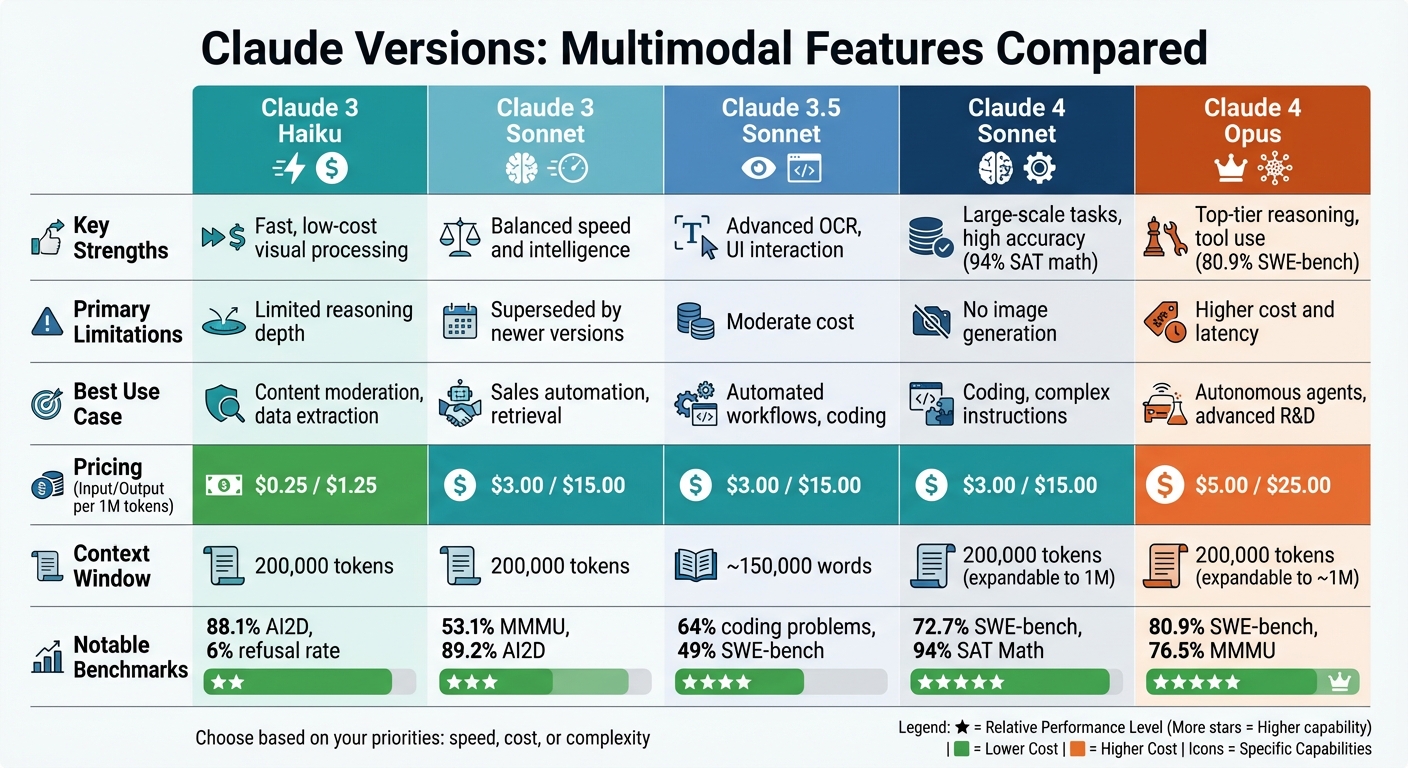
Claude AI Model Versions Comparison Chart: Features, Pricing, and Use Cases
Claude 4 Models & Claude Code Fundamentals In 24 Minutes
1. Claude 3 Haiku
Claude 3 Haiku marks a milestone as the first multimodal version in its series, setting a high standard for handling visual inputs with speed and precision.
Input Modalities
Claude 3 Haiku expands its capabilities with vision-based inputs. It can process a variety of formats, including photos, technical diagrams, charts, graphs, PDFs, flowcharts, and even presentation slides. With a massive 200,000-token context window, it efficiently handles lengthy documents or multiple images without breaking a sweat.
For example, it can analyze a 10,000-token research paper – complete with charts and graphs – in under three seconds. Anthropic touts it as "the fastest and most cost-effective model on the market for its intelligence category".
While the input side has evolved significantly, the output remains focused on delivering high-quality text and code.
Output Modalities
Claude 3 Haiku sticks to text and code outputs, steering clear of image generation. This targeted approach caters to enterprises that need robust analytical capabilities. Its knack for generating structured outputs like JSON makes it perfect for tasks like live chat support or customer service workflows.
Multimodal Benchmarks
When it comes to multimodal benchmarks, Claude 3 Haiku shines. It scored exceptionally well on the Chart Q&A benchmark using zero-shot, chain-of-thought prompting. It also consistently outperforms competitors like Gemini 1.0 Pro and GPT-3.5 in standard evaluations.
Its refusal rate for harmless prompts has dropped to about 6%, showcasing a more refined understanding compared to earlier versions. Plus, with pricing set at just $0.25 per million input tokens and $1.25 per million output tokens, it’s far more budget-friendly than Claude 3 Opus.
These strengths make it an excellent choice for seamless tool integration.
Tool Integration
Claude 3 Haiku is equipped to interact with external APIs and databases through function calling. This enables it to automate tasks like extracting data from receipts, identifying UI issues in screenshots, or performing OCR on technical diagrams. Additionally, it boasts improved fluency in languages like Spanish, Japanese, and French, broadening its appeal beyond English-speaking markets.
2. Claude 3 Sonnet
Claude 3 Sonnet stands out as a balanced performer in the Claude lineup, combining speed with advanced reasoning capabilities.
Input Modalities
Claude 3 Sonnet handles visual formats similar to Haiku but with improved reasoning skills. It boasts a 200,000-token context window, making it perfect for processing entire codebases or lengthy technical manuals. What truly sets it apart is its ability to manage complex data processing tasks. For instance, it scored 89.2% on the AI2D science diagram benchmark, edging out Haiku’s 88.1%. This makes it particularly suited for intricate visual data like laboratory notebooks or technical schematics.
The model also excels at working with PDFs and presentation slides. In evaluations across fields like finance, law, and medicine, domain experts preferred Sonnet’s outputs 60–80% of the time compared to earlier versions. These capabilities make it a strong choice for generating structured and efficient text outputs.
Output Modalities
With its advanced visual processing, Sonnet delivers refined text outputs, focusing exclusively on text without incorporating image or voice synthesis. It can produce up to 4,096 tokens per response at an impressive speed of 66.9 tokens per second, a notable leap from Claude 2.1’s 14.1 tokens per second. Its enhanced instruction-following capabilities ensure structured and precise outputs, ideal for tasks like natural language classification and sentiment analysis.
Multimodal Benchmarks
Claude 3 Sonnet achieved a 53.1% score on the MMMU (Multidisciplinary) benchmark, surpassing Haiku’s 50.2%. According to Anthropic, it’s "2x faster than Claude 2 and Claude 2.1". At $3.00 per million input tokens and $15.00 per million output tokens, it strikes a middle ground between Haiku’s affordability and Opus’s premium pricing. Its knowledge base extends through August 2023, and it features improved multilingual reasoning abilities in languages like Spanish, Japanese, and French.
Tool Integration
Sonnet is well-equipped for tasks like RAG (Retrieval-Augmented Generation), sales forecasting, and code generation, where both speed and precision are crucial. Its enhanced instruction-following capabilities allow seamless integration with external APIs and databases, making it a reliable choice for automated customer support and complex coding workflows.
3. Claude 3.5 Sonnet
Building on the advancements seen in Claude 3 Haiku and Sonnet, the 3.5 Sonnet version tackles both speed and functionality gaps head-on. Released in June 2024, with an upgraded version arriving in October 2024, this model represents a major step forward in multimodal AI. Anthropic described it as:
"Claude 3.5 Sonnet is our strongest vision model yet, surpassing Claude 3 Opus on standard vision benchmarks".
Let’s break down what makes Claude 3.5 Sonnet stand out, from its input and output capabilities to its benchmark performance.
Input Modalities
Claude 3.5 Sonnet takes visual processing to the next level. It can interpret complex visuals like charts, graphs, and technical diagrams with impressive precision. Its advanced OCR technology can even extract text from less-than-perfect images, such as screenshots or printed pages. With the ability to handle a massive context window of about 150,000 words, it can process entire codebases or lengthy academic papers in a single prompt.
A standout feature introduced in October 2024 is its "Computer Use" capability. This allows the model to interact with computer interfaces – perceiving screens and performing tasks like moving cursors, clicking buttons, and typing text. On the OSWorld benchmark, it scored 14.9% in the screenshot-only category, nearly doubling the 7.8% achieved by the next-best system.
Output Modalities
Claude 3.5 Sonnet doesn’t just generate text and code – it introduces Artifacts, a dedicated UI window that displays code snippets, web designs, and documents alongside the chat interface. This feature transforms the model into a collaborative workspace.
In October 2024, GitLab reported that using Claude 3.5 Sonnet improved reasoning during DevSecOps tasks by 10%, all without adding latency. The Browser Company also highlighted its superiority in automating web-based workflows, outperforming all previously tested solutions.
Multimodal Benchmarks
When it comes to benchmarks, Claude 3.5 Sonnet shines. It outperforms Claude 3 Opus on vision-related tests like MathVista, ChartQA, DocVQA, and AI2D. In internal coding evaluations, it solved 64% of problems, a significant leap from Claude 3 Opus’s 38%. The October 2024 upgrade further improved its SWE-bench Verified score from 33.4% to 49.0%.
The model also excelled in specialized tests. On a multimodal medical residency exam in Brazilian Portuguese, it matched human-level performance with 69.57% accuracy. In the OlympicArena benchmark, it outperformed GPT-4o in Physics (31.16% vs. 30.01%), Chemistry (47.27% vs. 46.68%), and Biology (56.05% vs. 53.11%). These achievements reinforce its role in driving enterprise efficiency.
Tool Integration
Claude 3.5 Sonnet builds on earlier versions by enhancing its tool integration capabilities. For example, its performance on TAU-bench improved significantly – rising from 62.6% to 69.2% in the retail sector and from 36.0% to 46.0% in the airline domain.
In October 2024, Replit incorporated the model’s computer use and UI navigation features into their Replit Agent, enabling developers to evaluate applications as they’re being built. With its ability to write, edit, and execute code autonomously, Claude 3.5 Sonnet is a powerful tool for automating development workflows. Pricing is set at $3.00 per million input tokens and $15.00 per million output tokens.
sbb-itb-f73ecc6
4. Claude 4 Sonnet
Claude 4 Sonnet, Anthropic’s hybrid reasoning model, represents a major step forward in multimodal AI capabilities. Building on its predecessors, this version combines advanced input handling with improved reasoning abilities. It offers two distinct modes: quick responses for simple tasks and extended reasoning for more complex challenges. This dual approach makes it versatile, handling everything from fast customer support to intricate software development.
Input Modalities
Claude 4 Sonnet processes a variety of input types, including text, images, charts, tables, and mixed-format documents like PDFs and technical diagrams in a single stream. Unlike earlier versions that required external preprocessing, this model seamlessly connects visuals with related text. For example, it can interpret a chart and its caption in one pass. Its 200,000-token context window allows it to handle massive documents or even entire codebases.
The 4.5 update brought noticeable improvements in data extraction. Accuracy for extracting information from image-heavy sources rose from around 67% in the initial release to approximately 80% in version 4.5. This means tasks like reconstructing tables from images or reading low-contrast screenshots are now far more reliable. These advancements pave the way for better output quality.
Output Modalities
Claude 4 Sonnet generates text, code, and structured files (like spreadsheets, slides, and documents) during conversations. With an expanded output limit of 64,000 tokens, it can produce extensive codebases or detailed architectural plans in a single response. Companies like Figma have seen impressive results with version 4.5:
"Claude Sonnet 4.5’s edit capabilities are exceptional – we went from 9% error rate on Sonnet 4 to 0% on our internal code editing benchmark".
The model also introduces step-by-step reasoning summaries for users who need more transparency in decision-making. Through the "Imagine with Claude" research preview, it can create functional software in real time, adapting to user input on the fly.
Multimodal Benchmarks
Claude 4 Sonnet shines across various evaluation metrics. It scored 72.7% on SWE-bench Verified for agentic coding tasks, outperforming Claude 4 Opus (72.5%) and leaving competitors like Gemini 2.5 Pro (63.2%) and GPT-4.1 (54.6%) far behind. On the OSWorld benchmark for computer use, its performance jumped from 42.2% in the initial release to 61.4% in version 4.5 – a nearly 20-point leap.
On SAT Math’s toughest questions, it achieved 94.0% accuracy (47 out of 50 correct), surpassing Claude 4 Opus (88.0%) and OpenAI o3 (86.0%). Additionally, it is 65% less likely than Claude 3.7 Sonnet to exploit shortcuts when completing tasks.
Tool Integration
The model’s tool integration adds another layer of functionality. Claude 4 Sonnet is equipped for extended reasoning with tool use, seamlessly alternating between analysis and actions like web searches or accessing local files. It supports parallel tool execution, meaning it can call multiple APIs at once to save time. Enhanced memory features allow it to save key information as "memory files" when working with local systems, ensuring continuity in long-running tasks.
GitHub has announced plans to incorporate the model into its new coding agent for GitHub Copilot. Meanwhile, Hai reported that Claude Sonnet 4.5 reduced the average vulnerability intake time for their security agents by 44%, while also improving accuracy by 25%. Pricing remains consistent with Claude 3.5 Sonnet at $3.00 per million input tokens and $15.00 per million output tokens, with up to 90% savings available through prompt caching.
5. Claude 4 Opus
Claude 4 Opus is Anthropic’s top-tier model designed for handling complex tasks. Initially launched in May 2025, it came with a price tag of $15.00 per million input tokens and $75.00 per million output tokens. However, a significant update in November 2025, known as version 4.5, brought costs down to $5.00 per million input tokens and $25.00 per million output tokens – a dramatic reduction of about 66%. Alongside these lower costs, the update introduced notable improvements in performance and multimodal processing.
Input Modalities
Claude 4 Opus takes input processing to another level. It can handle text, images, and files within a 200,000-token context window, which can be expanded to nearly 1 million tokens for tasks like analyzing entire code repositories. One standout feature is its ability to access local files (when granted permission by a developer), allowing it to extract and save critical information in "memory files" for use across sessions. This is complemented by the Files API, which simplifies how external data is processed. The 4.5 update also enhanced its vision capabilities, achieving a 76.5% score on the MMMU visual reasoning benchmark and 88.8% on the MMMLU test across 14 non-English languages.
Output Modalities
When it comes to output, Claude 4 Opus generates text, code, and structured data formats like JSON, YAML, and Markdown, with a maximum output size of 32,000 tokens. Its hybrid reasoning system allows it to switch between quick responses and more detailed, multi-step reasoning. It also provides summaries of its thought process for better clarity. The model is particularly skilled at computer-based tasks, such as generating precise code for browsing, performing Excel operations, and managing desktop applications. It scored 66.3% on the OSWorld benchmark and 80.9% on SWE-bench Verified.
"Claude Opus 4.5 is the only model that nails some of our hardest 3D visualizations. Polished design, tasteful UX, and excellent planning & orchestration".
Multimodal Benchmarks
Claude 4 Opus has delivered impressive results across various performance tests. It scored 72.5% on SWE-bench, significantly outperforming GPT-4.1’s 54.6%, and achieved 44% on Terminal-Bench Hard, the highest score documented by Artificial Analysis. Compared to Claude 3.5 Sonnet, it showed a 10.6% improvement on the Aider Polyglot benchmark, led in 7 out of 8 programming languages on SWE-bench Multilingual, and tied with Gemini 3 Pro by scoring 90% on MMLU-Pro. For agentic tasks, it outperformed Sonnet 4.5 by 29% on Vending-Bench. During a rigorous 2-hour internal technical exam, it achieved a score higher than any human candidate in Anthropic’s history. Additionally, the model is 65% less likely to exploit shortcuts or loopholes compared to Sonnet 3.7.
Tool Integration
Claude 4 Opus builds on its predecessors’ tool integration capabilities, now optimized for extended autonomous operations. It supports advanced reasoning paired with tool usage, seamlessly switching between tasks like web searches and file access. The model includes a sandboxed Python environment for code execution and a Model Context Protocol (MCP) for connecting to custom REST APIs. Developers can use a new "effort" parameter to balance speed, cost, and reasoning depth by selecting low, medium, or high settings. Another highlight is its ability to manage multi-agent orchestration. When paired with cost-efficient Haiku sub-agents, Opus 4.5 delivers a 12-point performance boost for search tasks compared to using Opus alone. It can also maintain its focus on autonomous tasks for up to 7 hours, with features like prompt caching and batch processing reducing costs by up to 90% and 50%, respectively.
Pros and Cons
Each Claude model is designed to meet specific enterprise needs, balancing speed, reasoning, and cost. Within the Claude 3 series, Claude 3 Haiku stands out for its speed and affordability, priced at just $0.25 per million input tokens. It’s an excellent choice for high-volume tasks like content moderation, capable of analyzing a 10,000-token research paper with charts in under three seconds. However, its reasoning capabilities are more limited. Claude 3 Sonnet offers a blend of speed and intelligence but has been largely surpassed by newer versions. On the other hand, Claude 3 Opus excels in recall, achieving over 99% accuracy on the "Needle In A Haystack" evaluation for documents up to 200,000 tokens. This comes at a premium price of $15.00 per million input tokens and $75.00 per million output tokens.
The newer generation models bring even more to the table. Claude 4 Sonnet is a strong all-rounder, offering a 1 million token context window and scoring 94% on the 50 toughest SAT math questions – outperforming GPT-4.5 and Gemini 2.5 Pro. With pricing set at $3.00 per million input tokens and $15.00 per million output tokens, and a low latency of 1.9 seconds, it’s well-suited for everyday coding and following complex instructions. Anita Kirkovska from Vellum shared high praise for this model:
"Claude 4 Sonnet is the best choice on the market now!"
However, none of the models currently support native image generation. On the integration side, Claude 4 models shine with features like parallel tool use, session memory, and local file access. A new "effort" parameter can reduce token usage by up to 76% for medium-effort tasks. Advanced models like Claude 4 Opus are particularly noteworthy for their specialized "Computer Use" capabilities, which allow for browser and desktop interaction. These features make it 65% less likely to exploit shortcuts in agentic tasks, though they come with higher costs and increased processing time.
Here’s a quick comparison of the models, their strengths, limitations, and ideal use cases:
| Model Version | Key Strengths | Primary Limitations | Best Use Case |
|---|---|---|---|
| Claude 3 Haiku | Fastest responses; lowest cost ($0.25/$1.25 per 1M tokens) | Limited reasoning depth; basic multimodal capabilities | Customer chat, content moderation, data extraction |
| Claude 3 Sonnet | Balanced speed and intelligence | Superseded by newer versions | Retrieval, sales automation, product recommendations |
| Claude 3 Opus | Exceptional recall (99%+ accuracy on "Needle In A Haystack") | High latency; premium pricing ($15.00/$75.00 per 1M tokens) | High-stakes document analysis, detailed retrieval |
| Claude 4 Sonnet | 1M token context window; 94% SAT math score; 1.9s latency | No native image generation; less reasoning depth than Opus | Everyday coding, complex instruction following |
| Claude 4 Opus | Advanced tool use, "Computer Use" features; 80.9% SWE-bench Verified | Higher cost and latency ($5.00/$25.00 per 1M tokens) | Autonomous agents, advanced R&D, complex software engineering |
Conclusion
Claude’s development represents a leap from simple vision processing to more dependable and practical applications. The Claude 3 series brought advanced vision capabilities, enabling it to analyze photos, charts, and technical diagrams with precision. Later iterations, like Claude 4 Sonnet and Claude 4.5 Opus, introduced cutting-edge "Computer Use" features, allowing the models to interpret and interact with graphical interfaces effectively. This focus on functionality sets Claude apart from competitors that prioritize audio and video generation, positioning it as a tool for engineering tasks and document analysis in practical scenarios.
Notably, GitHub has chosen Claude Sonnet 4 to power its updated coding agent in Copilot. Meanwhile, Cognition has commended the Opus variant for its ability to "successfully handle critical actions that previous models have missed".
FAQs
What are the main differences between Claude 3 Haiku and Claude 4 Opus?
Claude 3 Haiku is built for speed and cost-efficiency, making it a great choice for tasks that require quick processing and high volume, especially in real-time scenarios. It supports both text and image inputs, performing impressively on text-based tasks – often rivaling or even surpassing Claude 2. That said, it doesn’t offer the same depth in reasoning or achieve the higher benchmark scores seen in more advanced models.
Claude 4 Opus stands out as the most capable model in the fourth-generation lineup. It thrives in tasks that demand complex reasoning, advanced coding, and the ability to manage long-context inputs. Designed for high-stakes and mission-critical applications, it delivers top-tier performance, efficiency, and reliability. While it does come with a higher price tag, it’s a clear step up from the Claude 3 series in terms of overall capability.
To sum it up: Claude 3 Haiku is the go-to for speed and affordability, while Claude 4 Opus is tailored for precision and power in demanding workflows.
What is Claude 3.5 Sonnet’s ‘Computer Use’ feature, and how does it improve functionality?
Claude 3.5 Sonnet’s computer use feature takes the AI beyond text-based interactions by allowing it to work directly with graphical user interfaces (GUIs), much like a person would. It can interpret screenshots, move the cursor, click on buttons, and even type text. This means it can navigate websites, operate desktop applications, and manage multi-step workflows – all without needing custom scripts or manual intervention.
With this ability, Claude becomes more than just a text-based assistant. It can actively interact with software to handle tasks such as filing tickets, creating visual designs, or testing code. Although this feature is still in beta and may occasionally produce errors, it opens up new possibilities for automation, data entry, and real-time support – things that earlier versions simply couldn’t manage.
What makes Claude 4 Sonnet ideal for handling complex instructions?
Claude 4 Sonnet stands out for its ability to handle complex instructions with precision. Thanks to its advanced reasoning and step-by-step problem-solving skills, it can break down challenging tasks effectively. It also supports parallel tool usage and incorporates memory features, allowing it to manage multi-step workflows seamlessly. These traits make it a strong option for tasks that demand thorough understanding and agent-like execution.