
Claude, an AI-powered chatbot by Anthropic, is reshaping legal research by offering fast document analysis, plain-English explanations, and affordable pricing. Unlike platforms like Westlaw or Lexis+, which rely on verified legal databases and citation tools, Claude generates responses based on language patterns. While Claude excels in speed and cost, it struggles with accuracy, showing a 36% hallucination rate compared to Lexis+ AI’s 20%. This makes it better suited for initial drafting and analysis rather than final, citation-heavy tasks.
Key differences include:
- Accuracy: Claude scores 91.26/100 in legal reasoning but risks fabricating citations. Westlaw and Lexis+ ensure verified, jurisdiction-specific results.
- Cost: Claude starts at $20/month, while Lexis+ plans range from $171 to $658/month.
- Speed: Claude processes queries in ~1.9 seconds, faster than Westlaw’s 90 seconds or more.
- Capabilities: Claude handles large documents and PDFs (up to 1,500 pages via API) but lacks live access to court dockets or statutory updates offered by Westlaw and Lexis+.
For best results, use Claude for quick analysis and drafting, then verify with Westlaw or Lexis+ for compliance and accuracy. Combining both tools balances speed, cost, and precision.
Introducing Claude 3 5 Sonnet Anthropic Legal Use Case
How Claude Works for Legal Research
Claude operates as a reasoning tool rather than a traditional legal database. Instead of offering preloaded legal information, it analyzes documents – like contracts, case files, and discovery materials – using natural language processing. The Claude Opus 4.1 model can handle up to 170 pages (or 200,000 tokens) of content in one go, while the Sonnet 4 API expands this capacity to 1 million tokens, allowing users to process roughly 1,500 pages at once.
The platform supports various file types, including PDFs, DOCX files, and spreadsheets, with size limits of 30 MB in the chat interface and 500 MB via the API. Once uploaded, Claude indexes the content, enabling users to ask specific questions like, "What are the termination clauses on pages 45–52?" or "Summarize the indemnification language." It also provides page-anchored citations, directly linking responses to the original text – a crucial feature for ensuring accuracy and auditability in legal work. Additionally, Claude includes built-in OCR (optical character recognition) for scanned PDFs, converting up to 100 pages of image-based text into machine-readable content.
Processing Long Legal Documents
Claude approaches entire documents as unified entities rather than breaking them into smaller sections. This capability allows for more thorough analysis. In a study focused on IRAC-based legal analysis tasks, Claude scored 91.26 out of 100, surpassing Lexis+ AI’s 69.46. Mark Pike, Associate General Counsel at Anthropic, highlighted how this feature has streamlined his workflow:
"Before Claude, I had a ton of tactical busy work… things I would put off until the end of the day because I just knew it would take a lot of time, but not using the best parts of my brain."
For example, Pike’s team uses Claude to extract specific details from sublease agreements – such as parties involved, property addresses, rent terms, and unique provisions – in minutes rather than hours. For documents that exceed the model’s context window, a meta-summarization approach can be used: summarizing individual sections and then combining the summaries.
Legal Tools That Use Claude
Several legal technology platforms have integrated Claude into their systems. Thomson Reuters‘ CoCounsel uses Claude for document review and legal research in enterprise settings, while Robin AI incorporates it into their contract intelligence platform to simplify and summarize complex agreements. These tools often utilize the Model Context Protocol (MCP) to pull relevant context from external sources like Google Drive, Slack, and JIRA.
Anthropic’s internal legal team has also developed self-service tools using Claude, enabling non-legal staff to perform initial risk assessments on marketing materials. This has cut review times from 2–3 days to just 24 hours. Pike explains:
"We’re not replacing lawyers. We’re pushing out the frontier of what’s possible. We’re empowering them with the skills and tools they need to get their best work done."
To further enhance its functionality, the team has created "Skills", which are specialized instruction files that teach Claude specific tasks, such as writing in the style of an employment lawyer or formatting board minutes. These enhancements highlight Claude’s potential, though its limitations in certain areas of legal research remain.
What Claude Cannot Do
Despite its strengths, Claude is not a comprehensive legal database. Unlike platforms such as Westlaw or Lexis+, it doesn’t provide live access to court dockets, statutory updates, or verified case law. Instead, it depends entirely on user-supplied documents or external integrations via retrieval-augmented generation. For example, if you need to cite a recent Supreme Court decision or confirm the current status of a statute, you’ll need to source that information separately or use a traditional research platform.
Patrick Carver, CEO of Constellation Marketing, emphasized this limitation:
"Claude is not a legal research replacement and it is not a shortcut around your ethical responsibilities."
This underscores the importance of human oversight. While Claude excels at analyzing and summarizing provided documents, it cannot independently verify or access live legal data without external support.
How Legal Research Platforms Work
Traditional legal research platforms like Westlaw, Lexis+, and Bloomberg Law operate as vast legal databases rather than reasoning tools. These platforms house a wealth of primary sources, including case law, statutes, and regulations, alongside secondary resources like treatises, practice guides, and law reviews. For example, Westlaw alone boasts over 40,000 individual databases containing legal and public record data.
They rely on proprietary systems to organize and retrieve information. Take Westlaw’s West Key Number System, which categorizes more than 110,000 legal topics. Attorney-written headnotes and summaries further enhance the accuracy of search results. When you initiate a search, the platform runs a federated query across thousands of databases at once, pulling results from primary and secondary materials. This setup is fundamentally different from AI tools like Claude, which generate insights based on user-provided data.
Main Features and Strengths
One of the standout features of these platforms is their citator services, which ensure the validity of legal authorities. Westlaw uses KeyCite, while Lexis+ relies on Shepard’s Citation Service. These tools track how cases relate to one another, flagging instances where a decision has been overruled, questioned, or distinguished in later rulings.
Modern platforms also incorporate advanced technologies like natural language search, workflow automation, and specialized tools to streamline research. For instance, Westlaw’s Quick Check scans uploaded documents to verify quotes and citations, while Lexis+ Brief Analysis identifies research gaps in legal briefs. Bloomberg Law offers visual analytics tools, and Lexis+ features Ravel View, a graphical interface that uses circles and lines to map citing relationships between cases. These robust tools justify the premium pricing associated with these platforms.
Pricing and Subscription Models
Subscription costs for these platforms vary based on firm size and access needs. Lexis+ offers tiered pricing for small firms with 1–2 users. The Essential plan starts at $171 per month and covers state caselaw and court documents. The Enhanced plan, at $418 per month, includes federal caselaw and forms, while the Professional plan costs $658 per month and adds 50-state coverage, Law360, and CourtLink. Larger firms negotiate custom pricing.
Bloomberg Law takes a different approach with a flat, all-inclusive pricing model. This structure provides unrestricted access to tools, news, and both primary and secondary sources without additional per-click fees. AI-powered features, like Lexis+ AI, are typically offered as premium add-ons with pricing available upon request. Unlike Claude’s flat-rate system, the tiered subscriptions of these platforms reflect their meticulous data validation processes.
sbb-itb-f73ecc6
Claude vs Legal Research Platforms: Direct Comparison
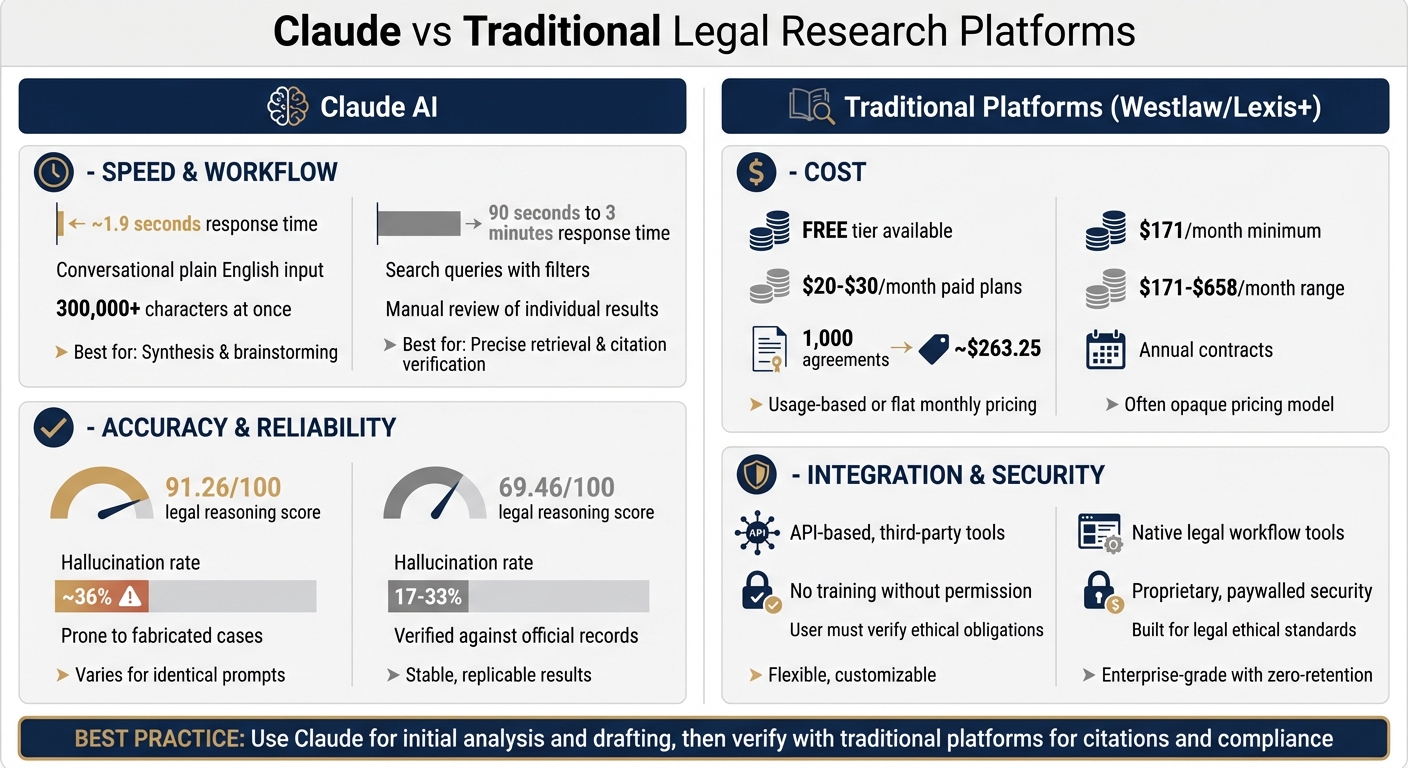
Claude vs Traditional Legal Research Platforms: Speed, Cost, and Accuracy Comparison
This section dives into how Claude and traditional legal research platforms stack up against each other. The comparison highlights differences that influence how lawyers conduct research, manage costs, and deliver results to clients.
Speed and Workflow Differences
Claude is lightning-fast, handling legal queries in about 1.9 seconds, while platforms like Westlaw Precision can take anywhere from 90 seconds to 3 minutes to generate results. This speed can be a game-changer when you’re summarizing lengthy contracts or drafting research memos on a tight deadline.
The workflow differences are also striking. Claude simplifies the process by responding to plain-English queries without requiring dropdowns or toggling through databases. As Samuel Edwards, CMO of Law.co, explains:
"GPT-powered agents don’t waste time asking you to ‘select jurisdiction’ from a dropdown menu… they parse questions quickly, drawing from massive datasets and delivering a response in seconds".
On the other hand, traditional platforms excel in precision. They allow users to filter by court, date, and citation status, ensuring that the retrieved information is highly specific. Claude can summarize extensive agreements – up to 300,000 characters in one go – whereas traditional platforms typically require manual review of individual search results.
| Feature | Claude | Traditional Platforms |
|---|---|---|
| Response Time | ~1.9 seconds | 90 seconds to 3 minutes |
| Input Method | Conversational, plain English | Search queries with filters |
| Document Capacity | 300,000+ characters at once | Manual review of individual results |
| Primary Strength | Synthesis and brainstorming | Precise retrieval and citation verification |
While Claude’s speed is a clear advantage, accuracy and reliability are equally important considerations.
Accuracy and Reliability
Claude’s reasoning capabilities are impressive, scoring 91.26/100 on structured legal reasoning tasks. However, it can sometimes "hallucinate", meaning it fabricates plausible but inaccurate case names or citations. For instance, general-purpose models like ChatGPT-4 have a hallucination rate of about 36% in legal contexts.
Traditional platforms reduce this risk by grounding their responses in verified court records. Even so, they aren’t flawless – AI-powered tools like Lexis+ AI and Westlaw AI-Assisted Research hallucinate between 17% and 33% of the time. Lexis+ AI has a hallucination rate of 20%, with an overall accuracy of 58% in legal testing, compared to ChatGPT-4’s 30%.
"AI should be seen as an enhancement, not a replacement, for rigorous legal research".
Claude is excellent for generating initial analysis and following frameworks, but it lacks the precision needed to ensure jurisdiction-specific citations. For example, it might accidentally cite a case from Alaska when you need one from New York. These accuracy challenges make it essential to balance speed with verified reliability.
| Feature | Claude | Traditional Platforms |
|---|---|---|
| Legal Reasoning Score | 91.26/100 (IRAC testing) | 69.46/100 (IRAC testing) |
| Hallucination Rate | ~36% | 17%–33% |
| Citation Verification | Prone to fabricated cases | Verified against official records |
| Result Consistency | Varies for identical prompts | Stable, replicable results |
The trade-off between speed and accuracy also impacts the cost-effectiveness of each option.
Cost Comparison
When it comes to pricing, the gap between Claude and traditional platforms is significant. Claude offers a free tier, with paid plans starting at $20 per month for Claude Pro and $30 per month for Claude Team. For API usage, Claude 4 Sonnet costs about $15 per million input tokens and $30 per million output tokens. Summarizing 1,000 legal agreements (approximately 300 million characters) with Claude Sonnet 4.5 costs around $263.25.
Traditional platforms, on the other hand, operate on pricey annual subscriptions. These costs vary depending on firm size and often require negotiation. As Samuel Edwards humorously puts it:
"Westlaw and LexisNexis operate on a pricing model that would make cable companies blush. Everything is paywalled, and if you dare to search the wrong database, expect an itemized bill that looks like you just bought a small yacht".
For small firms with 1–2 users, Lexis+ starts at $171 per month for basic state coverage, climbing to $658 per month for comprehensive 50-state access. Solo practitioners and small firms can save thousands annually by using Claude for initial drafting and summarization while verifying citations through traditional platforms. Larger firms often stick with full subscriptions for compliance and liability reasons, though many now use Claude to cut billable research hours by up to 80%.
| Feature | Claude | Traditional Platforms |
|---|---|---|
| Entry Price | Free tier available | Basic access starts at $171/month |
| Subscription Range | $20–$30/month (upgraded plans) | $171–$658/month (depending on coverage) |
| Pricing Model | Usage-based or flat monthly | Annual contracts, often opaque |
| Large-Scale Analysis | ~$263.25 for 1,000 agreements | Varies by subscription tier |
Integration and Data Security
Claude’s API integration allows firms to create custom tools and connect with platforms like CoCounsel. Its privacy-focused policy ensures no user prompts are used for training without permission. This gives firms greater control over sensitive client information, though it’s still crucial to ensure compliance with ethical standards.
Traditional platforms, meanwhile, offer robust native integrations tailored to legal workflows. Thomson Reuters’ CoCounsel, for example, uses prompting "guardrails" that limit responses to verified information databases, reducing the risk of unreliable content.
| Feature | Claude | Traditional Platforms |
|---|---|---|
| Integration Method | API-based, third-party tools | Native legal workflow tools |
| Data Training Policy | No training without permission | Proprietary, paywalled security |
| Compliance Framework | User must verify ethical obligations | Built for legal ethical standards |
| Access Control | Flexible, customizable | Enterprise-grade with zero-retention |
When to Use Each Option
Deciding whether to use Claude or traditional legal platforms boils down to the specific task you’re tackling. Each tool shines in different areas, and knowing when to rely on one – or combine them – can make a huge difference in both speed and precision. Here’s a closer look at what each option does best.
Best Uses for Claude
Claude is a powerhouse when it comes to handling large, unstructured datasets. Its ability to process extensive documents quickly makes it perfect for summarizing medical records, deposition transcripts, or other discovery materials. For example, if you need to extract key details from a 200-page file or build a timeline from testimony, Claude can manage it seamlessly without losing the bigger picture.
Drafting is another area where Claude stands out. It can cut down the time spent on creating demand letters, motions, and discovery responses by as much as 60% to 80%. Patrick Carver, CEO of Constellation Marketing, advises reviewing Claude’s drafts carefully, much like you would with work from a junior team member:
"You remain responsible for accuracy under Rule 1.1".
Claude also shines in preliminary research. Whether you’re diving into an unfamiliar legal doctrine or trying to untangle a complicated legislative history, it can provide a quick, clear overview. However, when using the public version rather than Claude 3.5 Sonnet for Enterprise, it’s important to use placeholders for sensitive client details or privileged information.
Best Uses for Legal Platforms
While Claude is great for initial analysis, traditional legal platforms like Westlaw and LexisNexis are still essential for tasks requiring verified citations and authoritative research. These platforms are indispensable for ensuring that a case remains valid through tools like Shepardizing or KeyCiting and for linking directly to primary legal sources. Michael Torres, a litigation partner, underscores this point:
"Even with GPT-4o and Claude 3.5, I’ve seen AI confidently cite non-existent cases. The hallucination problem is better but not solved. Legal-specific tools like CoCounsel with verified citations are essential for any work product that matters".
Another area where traditional platforms excel is jurisdictional specificity. They allow you to filter by state, court, and date, helping you avoid mistakes like citing an Alaska case when you need one from New York. For high-stakes research, such as court briefs, these platforms provide the verified, jurisdiction-specific information you can’t afford to miss.
Using Both Together
Pairing Claude with traditional legal platforms offers the best of both worlds. Claude can handle heavy-lifting tasks like document review, triage, and drafting, while traditional platforms can anchor your work with verified statutes and case law. For instance, you might use Claude to summarize a lengthy deposition and draft an initial memo, then turn to Westlaw to verify every citation before filing.
This combined approach is quickly becoming the norm. Currently, 61% of legal professionals use AI for case-law summaries, and 37% of firms use AI for tagging discovery documents, with 56% planning to integrate it soon. Nicole Black, an attorney and journalist, advocates for this strategy:
"Treat generative AI tools just as you would an entry-level associate and carefully review all responses to ensure their accuracy, including case citations and the cases themselves".
Conclusion
Deciding between Anthropic’s Claude Sonnet and traditional legal platforms comes down to understanding the strengths each brings to the table. Claude delivers impressive speed and efficiency at an affordable price, making it a great fit for solo practitioners and smaller firms. On the other hand, established platforms like Westlaw and LexisNexis are still indispensable for tasks like verifying citations, Shepardizing cases, and ensuring legal authority is upheld.
The real power lies in combining both tools. Claude can handle initial analysis and document review with ease, while traditional platforms step in for thorough validation and final checks. This combination creates a well-rounded legal research process. Plus, Claude’s policy of not using user data for training without explicit permission addresses a key concern for attorneys managing sensitive client information. This makes it a responsible and trustworthy addition to traditional research methods.
The legal field is clearly moving toward a more integrated approach, where AI takes care of routine tasks, freeing lawyers to focus on strategic decisions and detailed verification. As Samuel Edwards, CMO of Law.co, aptly states:
"The future of legal research isn’t an either-or scenario; it’s about leveraging the best of both worlds".
FAQs
How can Claude complement traditional legal research platforms effectively?
Claude serves as a quick, AI-powered assistant that works alongside established legal research tools like Westlaw, LexisNexis, or Bloomberg Law. By entering case-specific questions or uploading lengthy documents such as contracts or legal briefs, Claude can deliver concise summaries, pinpoint legal issues, and suggest relevant statutes or precedents – all within seconds. This can help cut down the time spent on initial research.
For accuracy, attorneys should treat Claude as a tool for brainstorming and drafting, while relying on traditional platforms to confirm citations and authorities. A practical workflow might look like this: first, use Claude to draft an analysis or highlight key issues; next, verify the suggested sources through a trusted database; and finally, refine the results with confirmed information. This approach blends Claude’s efficiency and reasoning with the dependability of established tools, balancing speed with precision.
What are the challenges of using Claude for legal research?
While Claude is a capable AI tool, it does come with some limitations when applied to legal research. One major concern is hallucinations – instances where it produces citations or case summaries that sound convincing but are actually incorrect. Because of this, every output requires thorough verification against reliable sources.
Another challenge lies in handling jurisdiction-specific rules. Claude can struggle to accurately interpret detailed state or federal statutes, which may lead to errors, especially in routine legal matters. Its accuracy also varies depending on the practice area, meaning users should view its responses as starting points rather than definitive answers.
Even with advanced methods like retrieval-augmented generation (RAG), these issues aren’t entirely resolved. Additionally, Claude’s context window limits can restrict the amount of information it can analyze in a single query, making it less effective for tackling complex legal problems.
At this stage, Claude is most useful as a supplementary tool. However, it’s crucial to cross-check its findings with trusted legal databases before relying on them.
Why should I double-check Claude’s results with traditional legal research tools?
While Claude is known for its speed and strong reasoning capabilities, generative AI tools aren’t flawless. They can sometimes produce errors, like fabricated citations or inaccurate case summaries. Research indicates that even advanced AI systems can deliver incorrect information roughly 17% of the time, which highlights the importance of human oversight.
That’s where traditional platforms like Westlaw, LexisNexis, and Bloomberg Law come into play. These tools offer verified sources and well-documented citation trails, giving attorneys the ability to double-check AI-generated insights and catch potential errors. This cross-referencing process not only ensures accuracy but also helps mitigate ethical risks and uphold the high standards expected in legal work. By blending Claude’s efficiency with the reliability of these established tools, you can streamline your workflow without sacrificing precision.