
Looking for the best AI for e-commerce? Here’s the breakdown:
Claude AI and ChatGPT are two leading tools transforming shopping experiences online. Each has its strengths, and the right choice depends on your needs:
- Claude AI: Best for handling large datasets, detailed product catalogs, and compliance-heavy tasks. Its 200,000-token context window processes extensive information like specifications, policies, and FAQs. Ideal for retailers needing precise, structured recommendations and strict adherence to rules.
- ChatGPT: Excels in dynamic, customer-facing interactions. Its conversational style, broad integrations (e.g., Shopify, Salesforce), and sales-driven approach make it perfect for personalized shopping, upselling, and real-time assistance.
Key Takeaways:
- Claude AI is better for back-end tasks like catalog management and compliance.
- ChatGPT shines in customer engagement, product discovery, and marketing.
- Many retailers combine both for optimal results – Claude for structure, ChatGPT for interaction.
Quick Comparison
| Feature | Claude AI | ChatGPT |
|---|---|---|
| Context Window Size | 200,000 tokens for large datasets | 128,000 tokens for most interactions |
| Personalization | Rule-based, consistent recommendations | Dynamic, conversational suggestions |
| Platform Integrations | Limited but focused (e.g., Salesforce) | Broad (e.g., Shopify, Zapier) |
| Best Use Case | Catalog management, compliance tasks | Customer-facing, sales-driven support |
Conclusion: Use ChatGPT for engaging shopping experiences and Claude AI for precise, back-office operations. Together, they cover all e-commerce needs.
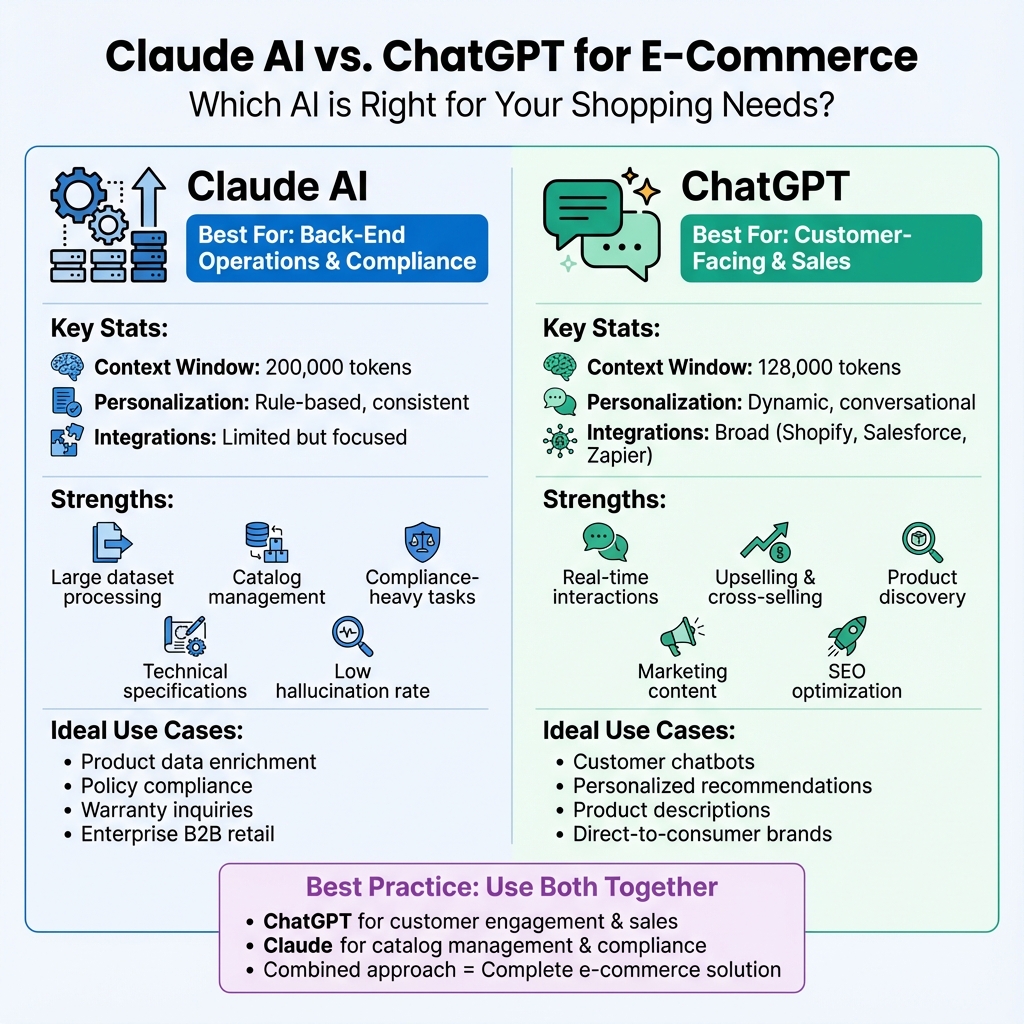
Claude AI vs ChatGPT for E-Commerce: Feature Comparison Chart
How Claude AI Handles Personalized Shopping

Language Understanding and Context Processing
Claude AI’s impressive 200,000-token context window enables it to process a massive amount of data in one go. This includes entire product catalogs, detailed specification sheets, size charts, FAQs, and policy documents. For U.S. shoppers making high-stakes purchases – like appliances, electronics, or furniture – this feature provides in-depth, consultative support.
Picture this: a shopper uploads laptop comparison tables, warranty details, and customer reviews. Claude can break down the trade-offs, highlight hidden fees in USD, and recommend the best options tailored to the shopper’s needs. It shines when tackling complex queries, such as finding women’s running shoes under $120, in U.S. size 8, with a wide fit for flat feet, sorted by comfort over style. Claude interprets these layered criteria, transforming them into actionable steps. It can also analyze detailed specs – like TV refresh rates or CPU performance benchmarks – and present clear pros and cons. This deep level of context understanding allows Claude to deliver highly accurate and personalized recommendations.
Product Recommendations and Customization
Claude leverages shopping data to craft tailored suggestions while keeping customer privacy intact. Retailers can provide anonymized customer insights – such as trends in premium outdoor gear purchases, average order values, or preferences like shoe size and favorite brands – without exposing raw personal information. Using this data, Claude can create custom recommendations, bundle offers, or upsell strategies that align with each shopper’s profile.
For retailers operating in compliance-sensitive environments, Claude’s rule-following ability is a game-changer. Merchants can set specific guidelines like "never show personalized pricing", "avoid inferring sensitive attributes", or "adhere to U.S. promotion disclosure laws", and Claude ensures these rules are followed. Whether focusing on budget-friendly options or emphasizing premium features like durability and extended warranties, Claude adjusts its suggestions to meet diverse customer needs while staying compliant with U.S. regulations.
E-Commerce Platform Integration
Claude doesn’t just understand data – it integrates seamlessly with e-commerce platforms to deliver real-world value. For example, it connects with platforms like Shopify and Salesforce to access live inventory, USD pricing, discounts, and customer purchase history. Through a storefront chat widget, Claude can interpret customer requests and provide personalized responses, including cart additions or bundle suggestions.
Within Salesforce, Claude works via APIs under strict permissions, accessing CRM data and Commerce Cloud product information. Sales teams can use a Claude-powered assistant to get tailored product recommendations based on purchase history and contractual requirements. Imagine a sales rep asking for holiday gift ideas under $500 that complement a customer’s current setup – Claude analyzes the data and suggests suitable SKUs along with helpful talking points. This approach is particularly useful in regulated B2B or enterprise retail settings, where Salesforce often serves as the primary system of record.
How ChatGPT Handles Personalized Shopping
Context Processing and Query Management
ChatGPT’s 128K-token context window in GPT-4 Turbo allows it to track extensive customer interaction histories within a single conversation. For example, a U.S. apparel retailer can input previous chat logs and customer preferences, enabling ChatGPT to remember specific details like a shopper’s preference for slim-fit jeans in size 32 or their spending limit of $150. This eliminates the need for repetitive questions and helps ChatGPT immediately tailor suggestions based on earlier feedback, such as fit concerns. It can also transform natural-language queries – like "I need cozy running shoes for New York winters" – into structured search filters. Shoppers can then refine their requests with simple follow-ups like "a bit cheaper" or "more minimalist design", bypassing the complexity of traditional on-site filters. This level of context management creates a seamless and efficient product discovery process, which is explored further below.
Product Discovery and Recommendation Support
While Claude focuses on deep contextual analysis, ChatGPT shines in generating dynamic content and providing real-time sales assistance. It’s particularly effective at sales-driven tasks like writing persuasive product descriptions, crafting upsell and cross-sell messages, and facilitating "virtual stylist" conversations that boost conversions. For instance, it can create A/B-testable copy for product pages, suggest product bundles based on items in a shopper’s cart, or compare options like mid-range laptops. By using anonymized behavioral data – such as recently viewed items, abandoned carts, wishlists, and past purchases – retailers can build preference profiles (e.g., "frequent buyer of mid-priced outdoor gear, average order value $120, prefers free shipping"). ChatGPT can then recommend complementary items, such as thermal base layers to pair with winter jackets, or suggest upgrades, all while adhering to U.S. privacy standards to protect sensitive customer information. Beyond recommendations, ChatGPT’s ability to integrate with other tools further enhances the shopping experience.
E-Commerce Tool Integration
ChatGPT connects seamlessly with e-commerce platforms like Shopify through apps and APIs. For example, a U.S.-based Shopify merchant can sync store data – such as catalog, inventory, and orders – with ChatGPT to answer questions like "Do you have this in size 8?" using the inventory API. It can also generate SEO-friendly descriptions for multiple SKUs in bulk. ChatGPT’s ecosystem extends across platforms like Salesforce, Zapier, and Microsoft 365, enabling robust workflow automation. This connectivity allows retailers to create streamlined processes: ChatGPT can interpret a customer query, access a recommendation engine, check live stock availability and shipping costs in USD, log the interaction in a CRM, and even trigger follow-up communications. These integrations make it simple to design end-to-end customer experiences, from personalized lookbooks to post-purchase care or loyalty-program assistance, ensuring a smooth and tailored shopping journey across U.S. e-commerce platforms.
Direct Comparison: Shopping Features
Feature Comparison Table
When deciding between Claude AI and ChatGPT for e-commerce shopping assistance, it’s crucial for U.S. retailers to understand how each AI aligns with specific shopping needs. The table below outlines their performance across five key areas that directly influence the customer experience.
| Feature | Claude AI | ChatGPT |
|---|---|---|
| Context Window Size | Handles up to 200,000 tokens – perfect for processing entire product catalogs, detailed spec sheets, or long policy documents in one session | Supports up to 128,000 tokens (GPT-4 Turbo) – sufficient for most shopping interactions and medium-sized product data sets |
| Personalization Accuracy | Excels in structured, segment-based personalization, following explicit merchandising rules and targeting specific customer groups; less flexible for real-time adjustments | Specializes in dynamic, conversational personalization, adapting on the fly as shoppers refine preferences, budgets in USD, and sizing needs |
| Product Recommendations | Provides consistent, rule-based recommendations across extensive SKU lists, ensuring brand compliance and adherence to guidelines | Offers engaging, sales-focused recommendations, ideal for interactive discovery and upselling |
| Customer Query Handling | Accurate and cautious, with a lower risk of errors – great for handling policy-heavy topics like returns, warranties, and regulated products | Fast and engaging, well-suited for high-volume, sales-oriented support and straightforward, conversion-driven conversations |
| Integration Options | Strong in structured data tasks like product tagging and enrichment via APIs; has a more limited integration ecosystem | Offers a broad integration ecosystem with platforms like Shopify, Salesforce, Zapier, Microsoft 365/Azure, custom GPTs, and a plugin marketplace |
These features translate directly into practical shopping solutions for retailers. For instance, Claude’s extensive context window can process entire product catalogs in one session, making it ideal for delivering precise recommendations based on comprehensive fit guides. On the other hand, ChatGPT thrives in multi-step shopping scenarios – whether assembling computer bundles or planning room décor – while factoring in U.S. sizing and budget constraints.
For many U.S. retailers, ChatGPT’s wide-ranging integrations with tools like Shopify provide seamless access to real-time inventory, USD pricing, and shipping information. Meanwhile, Claude is a standout for applying detailed rules consistently across massive product datasets, ensuring compliance and accuracy.
sbb-itb-f73ecc6
Real Shopping Applications for Both AIs
Product Content and Recommendations
In the world of e-commerce, these two AIs play a significant role in managing everything from crafting product descriptions to offering tailored shopping recommendations. ChatGPT stands out for its ability to create diverse titles, bullet points, and descriptions that align with platforms like Amazon, Walmart, and direct-to-consumer sites in the U.S. It’s especially skilled at interactive chats, adjusting recommendations on the fly while considering details like USD pricing and U.S. sizing standards.
On the other hand, Anthropic‘s Claude excels at structured and rules-based content creation. It’s perfect for standardizing technical specifications, adhering to brand style guides, and producing compliant descriptions for more complex or technical products. Retailers can provide Claude with extensive spec sheets or catalogs – up to 200,000 tokens – and receive consistent, attribute-rich content that ensures smooth filtering, search functionality, and precise recommendations across their platforms. For guided selling, Claude thrives when there’s a clear logic to follow, such as recommending specific tiers of products based on customer needs (e.g., running shoes for those logging over 20 miles per week). It also integrates large internal documents like policies, catalogs, or reviews to inform its suggestions. These capabilities pave the way for more advanced customer interactions and deeper data-driven insights.
Customer Service and Chatbots
Building on their content creation strengths, both AIs extend their utility to customer service and chatbot functions. ChatGPT is highly effective for handling high-volume tasks such as answering questions about order tracking, shipping times, return statuses, and pre-sale inquiries like "Do you ship to California?" or "What’s the warranty?" Through API integration, ChatGPT can pull live order data, check inventory, and even suggest add-ons, making it ideal for sales-focused chatbots that aim to upsell products.
Meanwhile, Claude is better suited for complex or consultative support scenarios. It’s particularly helpful when customers need detailed explanations, nuanced reasoning, or assistance with compliance-heavy inquiries – like questions about electronics warranties, healthcare-related products, or age-restricted items. Claude’s low-hallucination approach makes it a safer choice for sensitive situations. Many retailers use Claude as an "advisor" for human agents handling high-risk cases. In these scenarios, Claude summarizes ticket histories and suggests policy-compliant responses, which agents can review before sending.
Data Analysis and Personalization
Beyond content creation and customer service, both AIs are instrumental in analyzing customer data to drive strategic insights. Claude is particularly adept at processing large volumes of text, such as clustering recurring complaints from thousands of support tickets, identifying top issues by product, and suggesting updates to descriptions, sizing guides, or packaging. It also excels in enabling segmentation-based personalization while adhering to strict internal guidelines.
ChatGPT, with its broad integration capabilities, makes it seamless to connect insights directly into marketing tools and dashboards for real-time, behavior-driven personalization. It can pinpoint drop-off points in the customer journey (like customers adding items to their cart but not completing checkout), propose targeted solutions such as reminders or discounts in USD, and create A/B test variations for email subject lines or ad campaigns. When connected to live data, ChatGPT dynamically adjusts offers and messaging throughout the shopping experience, ensuring a more personalized approach for each customer.
Which AI Works Best for E-Commerce Shopping?
Main Findings
ChatGPT stands out as the go-to option for customer-facing shopping experiences. It thrives in areas like dynamic product discovery, conversational chatbots designed for upselling and cross-selling, and real-time personalization that adjusts instantly to user behavior. With integrations like Shopify, Salesforce, Zapier, and GPT Store, it connects seamlessly to live inventory, USD pricing, and customer data, creating an engaging and interactive shopping experience. Additionally, it’s highly effective in creative tasks, such as crafting SEO-friendly product descriptions to boost marketing efforts.
On the other hand, Anthropic’s Claude is better tailored for back-office operations and workflows requiring strict compliance. Its ability to handle up to 200,000 tokens makes it perfect for processing extensive catalogs, technical specifications, and policy documents in a single instance. This makes it ideal for tasks like enriching product data, ensuring consistent attribute tagging, and generating structured content. With a lower tendency for errors and a more cautious approach, Claude is a safer bet for regulated industries, warranty-related inquiries, and tasks where accuracy and adherence to policy are critical.
In essence, ChatGPT is better suited for dynamic, customer-facing interactions that drive revenue, while Claude excels in managing large-scale catalog operations and compliance-heavy tasks. Many U.S. retailers achieve optimal results by combining both: using ChatGPT for marketing, product discovery, and high-volume customer service, and relying on Claude for catalog management, compliance checks, and complex support scenarios.
Final Recommendation
Given their respective strengths, ChatGPT is the top choice for dynamic shopping assistance. It shines in delivering personalized offers, interactive product finders, and budget-based recommendations, making it especially valuable for direct-to-consumer brands and marketplaces focused on engagement, upselling, and seamless integration with existing e-commerce platforms.
For large catalog operations, compliance-sensitive support, or highly technical product environments, Claude is the better option. It’s particularly well-suited for tasks like standardizing attributes across massive SKU lists, creating policy-compliant product descriptions, or addressing detailed warranty questions. Enterprise retailers, especially those working in regulated sectors like healthcare or electronics, will appreciate its precision and reliability.
If resources allow, deploying both AIs is the most effective strategy. Use ChatGPT for customer-facing personalization and engagement, and Claude for internal data management and support workflows. Together, they deliver a well-rounded solution for e-commerce shopping needs.
FAQs
How do Claude AI and ChatGPT work together to improve online shopping?
Claude AI and ChatGPT work hand-in-hand in e-commerce, blending their strengths to enhance the shopping experience. Claude shines when it comes to tackling complex reasoning and managing intricate tasks, while ChatGPT stands out for its ability to create engaging conversations and craft compelling content. Together, they bring a balance of efficiency and personalization to the table.
By combining Claude’s ability to handle ethical considerations and multitask with ChatGPT’s knack for conversational interaction, businesses can offer smarter, more customized, and seamless shopping experiences that leave customers satisfied.
Which AI is better for managing compliance-focused tasks in retail?
Claude AI, created by Anthropic, stands out as a reliable tool for handling compliance-focused tasks in the retail sector. Built with a strong focus on ethical behavior, transparency, and responsible AI practices, it’s designed to align closely with regulatory standards. Its emphasis on value alignment and advanced reasoning makes it especially effective for tasks that demand strict adherence to rules and policies.
How does ChatGPT integrate with e-commerce platforms to enhance shopping experiences?
ChatGPT plays a key role in elevating e-commerce platforms by serving as virtual assistants and chatbots, as well as offering personalized product recommendations. It also takes on tasks like automating customer service, crafting product descriptions, and analyzing customer data to refine user experiences.
By leveraging these features, businesses can provide smoother and more customized shopping experiences, making online shopping easier and more enjoyable for customers.