
Choosing between Claude 4.5 and Gemini 3 depends on your business needs. Here’s a quick summary:
- Claude 4.5: Ideal for industries prioritizing accuracy and security, such as healthcare, finance, and legal. It excels in coding, document analysis, and regulatory compliance, with features like a 200,000-token context window (expandable to 1 million in beta), Memory Tool, and HIPAA compliance. It scored 80.9% on SWE-bench Verified (software engineering tasks) and offers advanced tools like effort parameter settings for token optimization.
- Gemini 3: Best for speed, scalability, and multimodal tasks (text, images, video, audio, and code). With a 1-million-token context window (expandable to 2 million for enterprise), it processes large datasets efficiently. It integrates seamlessly with Google Workspace and excels in research, sales, and data analysis. Scored 91.9% on GPQA Diamond (scientific reasoning) and offers features like Deep Think mode and autonomous task handling.
Cost Comparison:
- Claude 4.5: $5.00/million input tokens, $25.00/million output tokens.
- Gemini 3: $2.00/million input tokens, $12.00/million output tokens (doubles for context windows over 200,000 tokens).
Quick Comparison:
| Feature | Claude 4.5 | Gemini 3 | Best Option |
|---|---|---|---|
| Context Window | 200,000 tokens (1M in beta) | 1,000,000 tokens (2M for enterprise) | Gemini 3 |
| Coding (SWE-bench) | 80.9% | 76.2% | Claude 4.5 |
| Scientific Reasoning | 84% | 91.9% | Gemini 3 |
| Multimodal Input | Text, Images | Text, Images, Video, Audio | Gemini 3 |
| Pricing (Input/Output) | $5.00 / $25.00 per million | $2.00 / $12.00 per million | Gemini 3 |
| Processing Speed | 49 tokens/sec | 128 tokens/sec | Gemini 3 |
| Enterprise Security | HIPAA, E2E encryption | Google Cloud SLAs | Claude 4.5 |
Claude 4.5 is better for precision-heavy tasks, while Gemini 3 is designed for large-scale, multimodal workflows. Both offer free tiers and discounts for batch processing, but Gemini 3 is more cost-effective for high-volume tasks. Choose based on your specific priorities – accuracy and security for Claude, speed and versatility for Gemini.
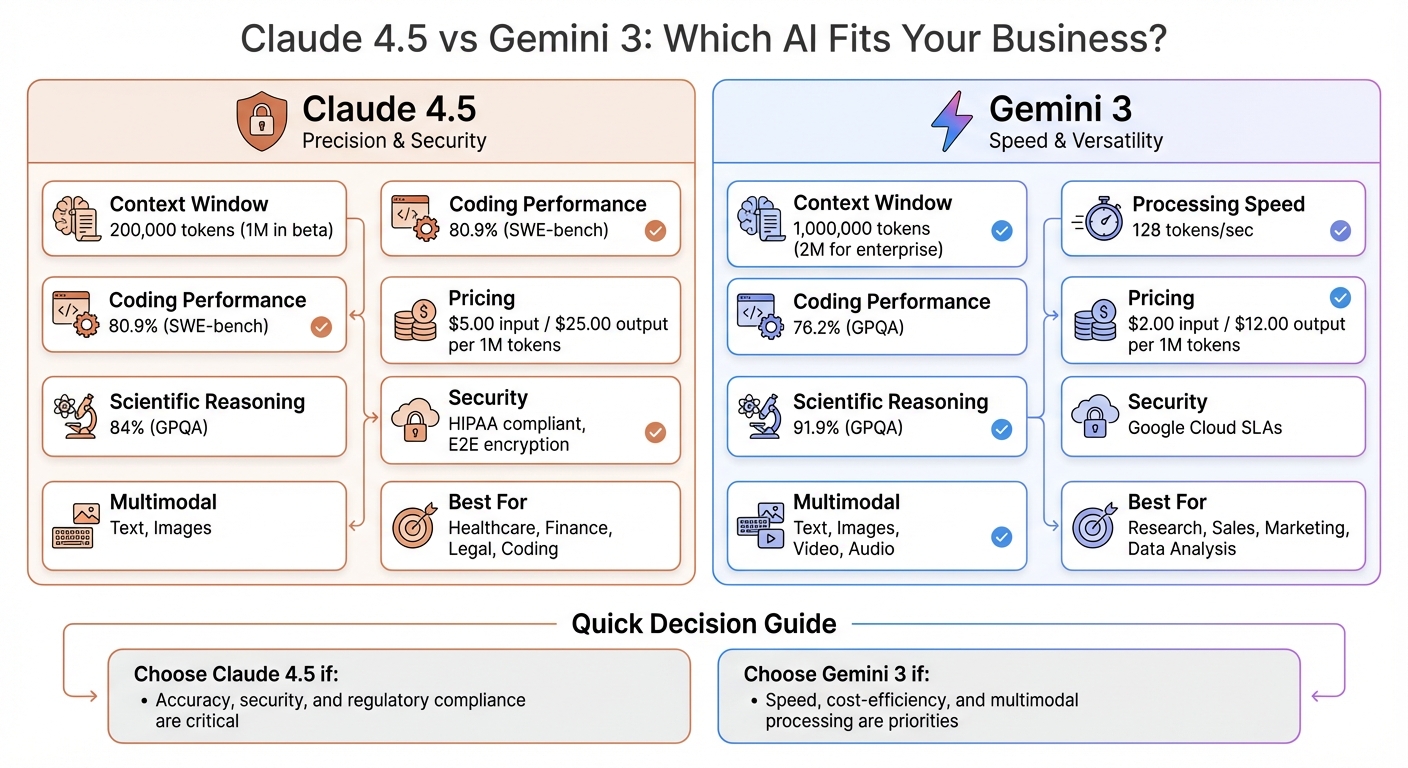
Claude 4.5 vs Gemini 3: Feature Comparison for Business AI
Claude 4.5: Features and Capabilities

Main Features of Claude 4.5
Claude 4.5 introduces a 200,000-token context window across its models – Opus, Sonnet, and Haiku. Notably, Sonnet 4.5, in beta, pushes this even further with a 1 million-token window. This extended capacity is designed to handle large-scale documents, lengthy projects, and intricate analyses with ease.
The Memory Tool (Beta) enhances functionality by storing and retrieving information outside the active context window. This allows Claude to maintain project continuity across multiple sessions. Another feature, Context Editing (Beta), ensures efficiency by automatically clearing older tool calls while keeping recent, relevant details intact.
A standout addition in Claude Opus 4.5 is the effort parameter, which lets users choose between "low", "medium", and "high" effort modes. This feature helps balance the depth of responses with token costs. For example, in medium effort mode, Opus 4.5 matches Sonnet 4.5’s output quality while using 76% fewer tokens. On the technical front, Claude 4.5 achieved an 80.9% score on SWE-bench Verified, a benchmark for software engineering tasks, marking the highest performance recorded as of late 2025. It also scored 66.3% on OSWorld, showcasing its capabilities in autonomous desktop operations.
These features make Claude 4.5 a strong performer in addressing complex business needs.
Business Applications
Claude 4.5 shines in contract reviews and document analysis, providing detailed redlines, tracked changes, and annotations directly within files. In financial modeling, internal testing revealed a 20% improvement in accuracy and a 15% boost in efficiency for Excel automation and related tasks compared to earlier versions.
For legacy system migrations, the model has proven effective in code refactoring and migration tasks, often cutting token usage by half and significantly reducing tool calls and build/lint errors by 50%–75%. In January 2026, Accenture announced plans to train 30,000 employees on Claude 4.5 to implement AI-driven solutions in industries like financial services and healthcare. Additionally, the terminal application Warp reported a 15% performance improvement over Sonnet 4.5 on the Terminal Bench evaluation, particularly for long-term autonomous tasks in "Planning Mode".
Gemini 3: Features and Capabilities
Main Features of Gemini 3
Gemini 3 is designed to process text, images, video, audio, and code seamlessly within a single framework. This capability makes it an ideal tool for handling business tasks that require analyzing and synthesizing information from multiple data formats.
One standout feature is its massive 1 million-token context window, which can be expanded to 2 million tokens for enterprise users. This allows Gemini 3 to tackle large-scale tasks, such as analyzing entire codebases, reviewing hours of video content, or processing thousands of pages of documents in one go. In late 2025, Gemini 3 Pro achieved a milestone score of 1,501 Elo on the LMArena Leaderboard, highlighting its advanced abilities. Its multimodal performance also stood out, with scores of 81% on MMMU-Pro and 87.6% on Video-MMMU.
Another game-changing feature is the Gemini Agent, which autonomously handles multi-step tasks like inbox organization, travel bookings, and supply chain management. It can even generate full front-end interfaces from a single prompt. Additionally, the model includes a "Deep Think" mode, which excels in handling complex, high-level problems. This mode achieved an impressive 91.9% score on the GPQA Diamond benchmark, showcasing its advanced reasoning capabilities.
"Gemini 3 is a major leap forward for agentic AI. It follows complex instructions with minimal prompt tuning and reliably calls tools, which are critical capabilities to build truly helpful agents."
- Mikhail Parakhin, CTO, Shopify
These features make Gemini 3 a powerful solution for tackling diverse and intricate business challenges.
Business Applications
Gemini 3 integrates seamlessly with Google Workspace, enabling users to summarize documents, draft content, and analyze data directly within its interface.
For instance, in late 2025, Sports Basement adopted Gemini with Workspace for customer service operations. This change led to a 30–35% reduction in the time spent drafting customer responses, replacing over 100 static templates with faster, AI-driven messaging.
In research and intelligence workflows, Gemini 3’s Deep Research agent is a standout. It processes vast amounts of unstructured data with web grounding, delivering insights at remarkable speed. Presentations.AI demonstrated this in November 2025 by using Gemini 3 to analyze company data and create strategic sales content in just 90 seconds – a task that previously took analysts six hours. Gemini 3 also connects securely to platforms like Google Workspace, Microsoft 365, Salesforce, SAP, and BigQuery, ensuring context-aware insights tailored to specific needs.
For sales and data analysis, Gemini 3 shines in extracting structured information from complex formats. In November 2025, Rakuten Group, Inc. used Gemini 3 Pro to transcribe 3-hour multilingual meetings with advanced speaker identification and to extract structured data from low-quality document photos, outperforming other models by over 50%. Similarly, Geotab reported a 10% improvement in response accuracy for complex code-generation tasks and a 30% reduction in tool-calling errors after implementing Gemini 3 Pro for multi-step planning.
When it comes to modernizing legacy systems, Gemini 3’s extensive context window is a game-changer. It can refactor entire codebases and automate software testing. Wayfair piloted Gemini 3 Pro in late 2025 to transform intricate partner support SOPs into data-accurate infographics for field associates, making complex information easier to understand.
"Gemini 3 Pro brings a new level of multimodal understanding, planning, and tool-calling that transforms how Box AI interprets and applies your institutional knowledge."
- Ben Kus, CTO, Box
Claude Opus 4.5 vs. Google Gemini 3: Design & build an app
Claude 4.5 vs. Gemini 3: Direct Comparison
Let’s dive into how Claude 4.5 and Gemini 3 stack up against each other in key performance areas. When it comes to software engineering, Claude 4.5 stands out with an 80.9% SWE-bench Verified score, outperforming Gemini 3 Pro’s 76.2%. This makes Claude 4.5 a strong choice for creating production-ready code that requires minimal revisions.
On the other hand, Gemini 3 shines in speed and scalability. It processes 128 tokens per second, compared to Claude 4.5’s 49 tokens per second. Additionally, Gemini 3 offers a context window five times larger, accommodating up to 1,000,000 tokens – ideal for analyzing massive datasets like entire codebases or lengthy video content in one go. For scientific reasoning, Gemini 3 Pro also takes the lead, scoring 91.9% on the GPQA Diamond benchmark, compared to Claude 4.5’s 84%. These distinctions set the groundwork for evaluating which model aligns better with specific business needs.
Pricing Comparison
The cost differences between the two models are also worth noting. Gemini 3 Pro is significantly cheaper, charging $2.00 per million input tokens and $12.00 per million output tokens, while Claude 4.5’s rates are $5.00 and $25.00, respectively. However, Gemini 3’s pricing doubles for context windows exceeding 200,000 tokens.
Interestingly, there are scenarios where Claude 4.5’s higher accuracy on complex tasks makes it the more economical option overall. As Camille, a developer and author, puts it:
"Claude 4.5’s higher ‘first-pass correctness’ on complex tasks sometimes made it the cheaper option overall." – Camille, Developer/Author
Feature Comparison Table
Here’s a quick breakdown of how the two models compare across different features:
| Feature | Claude 4.5 | Gemini 3 Pro | Winner |
|---|---|---|---|
| Context Window | 200,000 tokens | 1,000,000 tokens | Gemini 3 |
| Coding (SWE-bench) | 80.9% | 76.2% | Claude 4.5 |
| Scientific Reasoning (GPQA) | 84.0% | 91.9% | Gemini 3 |
| Multimodal Input | Text, Images | Text, Images, Video, Audio | Gemini 3 |
| Pricing (Input/Output per 1M tokens) | $5.00 / $25.00 | $2.00 / $12.00 | Gemini 3 |
| Processing Speed | 49 tokens/sec | 128 tokens/sec | Gemini 3 |
| Enterprise Security | HIPAA, role-based access, E2E encryption | Google Cloud/Vertex SLAs | Claude 4.5 |
| Special Features | Memory Tool, Effort Parameter | Deep Think, Generative UI | Tie |
Choosing the Right Model
Ultimately, the choice between Claude 4.5 and Gemini 3 depends on your priorities. Claude 4.5 excels in technical precision and security, offering HIPAA compliance and end-to-end encryption, which makes it an excellent fit for industries with strict regulatory requirements. Meanwhile, Gemini 3 is ideal for tasks requiring speed, scalability, and multimodal input capabilities, especially for teams already integrated with Google Workspace. Whichever you choose, understanding these strengths ensures the model aligns with your operational goals and industry demands.
sbb-itb-f73ecc6
Which AI Fits Your Business Needs?
Selecting the right AI depends on your business tasks and priorities. Each model is tailored for specific workflows. Claude 4.5 shines in scenarios where precision is key, like software development, legal reviews, or financial modeling. On the other hand, Gemini 3 is designed for speed, multimodal capabilities, and seamless integration with the Google ecosystem. Here’s a closer look at when each model is the better fit.
When Claude 4.5 Works Best
Claude 4.5 is your go-to when accuracy takes precedence over speed. It’s particularly well-suited for production-ready software development. In fact, in late 2025, Replit reported that Claude achieved a 0% error rate on their internal code editing benchmark – an impressive leap from earlier versions.
For industries with strict regulations, such as healthcare and finance, Claude 4.5 provides the necessary safeguards. Its Constitutional AI safety framework and end-to-end encryption ensure compliance with standards like HIPAA. If you’re developing agents that require sustained coherence over 30+ hours or handling mission-critical backend logic, Claude 4.5 is a dependable choice. However, for tasks involving high volume or multimodal data, Gemini 3 may be the better option.
When Gemini 3 Works Best
Gemini 3 is built for speed and scalability. Its 1 million-token window allows it to analyze massive datasets, such as extensive codebases, lengthy recordings, or multiple reports, all in one go. In October 2025, Gap incorporated Gemini Enterprise to speed up trend analysis through its seamless integration with Google Workspace.
For businesses reliant on multimodal workflows, Gemini 3 is a standout. It effortlessly processes text, images, video, and audio without requiring preprocessing. This makes it ideal for tasks like analyzing production line diagrams, reviewing failure descriptions, or creating interactive UIs from visual mockups.
Gemini 3 also excels in scientific reasoning, achieving a 91.9% score on GPQA Diamond and even outperforming human experts in graduate-level science and logic tests. If your team handles massive datasets or conducts real-time market research using integrated Google Search, Gemini 3’s Deep Research mode is specifically designed for these challenges. It also offers a cost advantage, priced at $2.00 per million input tokens compared to Claude 4.5’s $5.00 – a clear edge for high-volume tasks.
For businesses already using Google Workspace, Gemini 3 integrates seamlessly without the need for custom API setups. If budget efficiency and processing speed are your main concerns, Gemini 3 offers an excellent balance of performance and cost.
Pricing and Access for Businesses
When it comes to cost, understanding the pricing structure is crucial. Both Claude 4.5 and Gemini 3 offer free tiers, but their paid plans differ in price and features. Claude 4.5 Pro is priced at $20 per month (or $17 per month with annual billing), while Gemini 3’s basic tier costs $19.99 per month. For businesses needing advanced reasoning capabilities, Gemini 3 offers its AI Ultra subscription – which includes Deep Think mode – at $249.99 per month.
Looking at API pricing, Gemini 3 Pro charges $2.00 per million input tokens and $12.00 per million output tokens, making it about 60% and 52% cheaper, respectively, than Claude 4.5 Opus, which costs $5.00 for input tokens and $25.00 for output tokens.
Claude 4.5 provides three API variants to suit different needs:
- Opus: $5.00 per million input tokens and $25.00 per million output tokens, ideal for mission-critical tasks.
- Sonnet: $3.00 per million input tokens and $15.00 per million output tokens, a mid-tier option.
- Haiku: $1.00 per million input tokens and $5.00 per million output tokens, designed for high-volume, budget-conscious use cases.
Both platforms offer a 50% discount on batch processing for non-urgent workloads, making them more affordable for large-scale tasks.
These pricing options allow businesses to align their choices with both performance requirements and budget constraints.
Pricing Breakdown Table
| Feature | Claude 4.5 | Gemini 3 |
|---|---|---|
| Pro Plan | $20/month | $19.99/month |
| Premium Tier | Max: $100–$200/month | AI Ultra: $249.99/month |
| Free Tier | Available (usage limited) | 50 tasks/month |
| API Input (per 1M tokens) | Opus: $5.00 / Sonnet: $3.00 / Haiku: $1.00 | $2.00 (<200K) / $4.00 (>200K) |
| API Output (per 1M tokens) | Opus: $25.00 / Sonnet: $15.00 / Haiku: $5.00 | $12.00 (<200K) / $18.00 (>200K) |
| Context Window | 200,000 tokens | 1,000,000 tokens |
| Batch Discount | 50% | 50% |
| Enterprise Features | Advanced admin controls, SSO, Claude Code integration | Vertex AI Integration |
For enterprise users, Claude 4.5 plans start at $30 per user per month (minimum of five users), offering features like advanced admin controls, single sign-on (SSO), and Claude Code integration. On the other hand, Gemini 3 integrates seamlessly with Vertex AI, showcasing a faster scaling capability – experiencing only a 2-second slowdown at 20 users compared to a 5-second delay for Claude 4.5.
Both platforms are available across multiple channels – Claude 4.5 can be accessed via the Anthropic API, AWS Bedrock, and Google Vertex AI, while Gemini 3 is accessible through Google AI Studio and Vertex AI.
How to Choose Between Claude 4.5 and Gemini 3
Deciding between Claude 4.5 and Gemini 3 comes down to your specific workflow requirements. If your tasks involve coding, legal reviews, or precision-heavy projects, Claude 4.5 is a strong contender. On the other hand, Gemini 3 shines in multimodal processing, research, and handling high-volume tasks where speed and cost efficiency are priorities.
When it comes to token capacity, Gemini 3 supports up to 1 million tokens, making it ideal for working with massive datasets. Meanwhile, Claude 4.5’s 200,000-token limit is sufficient for most enterprise-level tasks.
Another key distinction lies in their integrations. Gemini 3 works seamlessly with Google Workspace, while Claude 4.5 offers multi-cloud compatibility through AWS Bedrock and Google Vertex AI.
Best Fit by Industry and Task
To determine which model aligns best with your industry and needs, it’s helpful to look at their strengths.
Claude 4.5 is tailored for industries like finance, legal, and healthcare, where reliability and security are paramount. Its Constitutional AI safety framework and end-to-end encryption make it HIPAA-compliant, making it a safe choice for handling sensitive information. For tasks requiring meticulous document analysis, Claude 4.5 excels, particularly in fields where precision is critical. For example, in backend engineering, Claude has outperformed Gemini 3 Pro, achieving an 80.9% score on the SWE-Bench Verified benchmark compared to Gemini’s 76.2%.
On the other hand, Gemini 3 is a natural fit for sectors such as tech, sales, retail, and marketing. Its strength lies in speed, multimodal capabilities, and real-time insights. With native Google Search integration, it’s perfect for market research and trend analysis. Companies like Box Inc. have reported a 15% improvement in extracting structured data from complex financial PDFs using Gemini 3 Flash. Additionally, JetBrains leverages Gemini 3 Flash for production-level code assistance, citing its efficiency and high throughput. For frontend and design tasks, Gemini’s Generative UI feature can turn visual mockups into functional code with impressive accuracy.
"Gemini 3 feels like a fast, well-connected operator in the Google stack. Claude 4.5 feels like a careful, articulate analyst." – Camille, Developer
Fello AI: Access Multiple AI Models
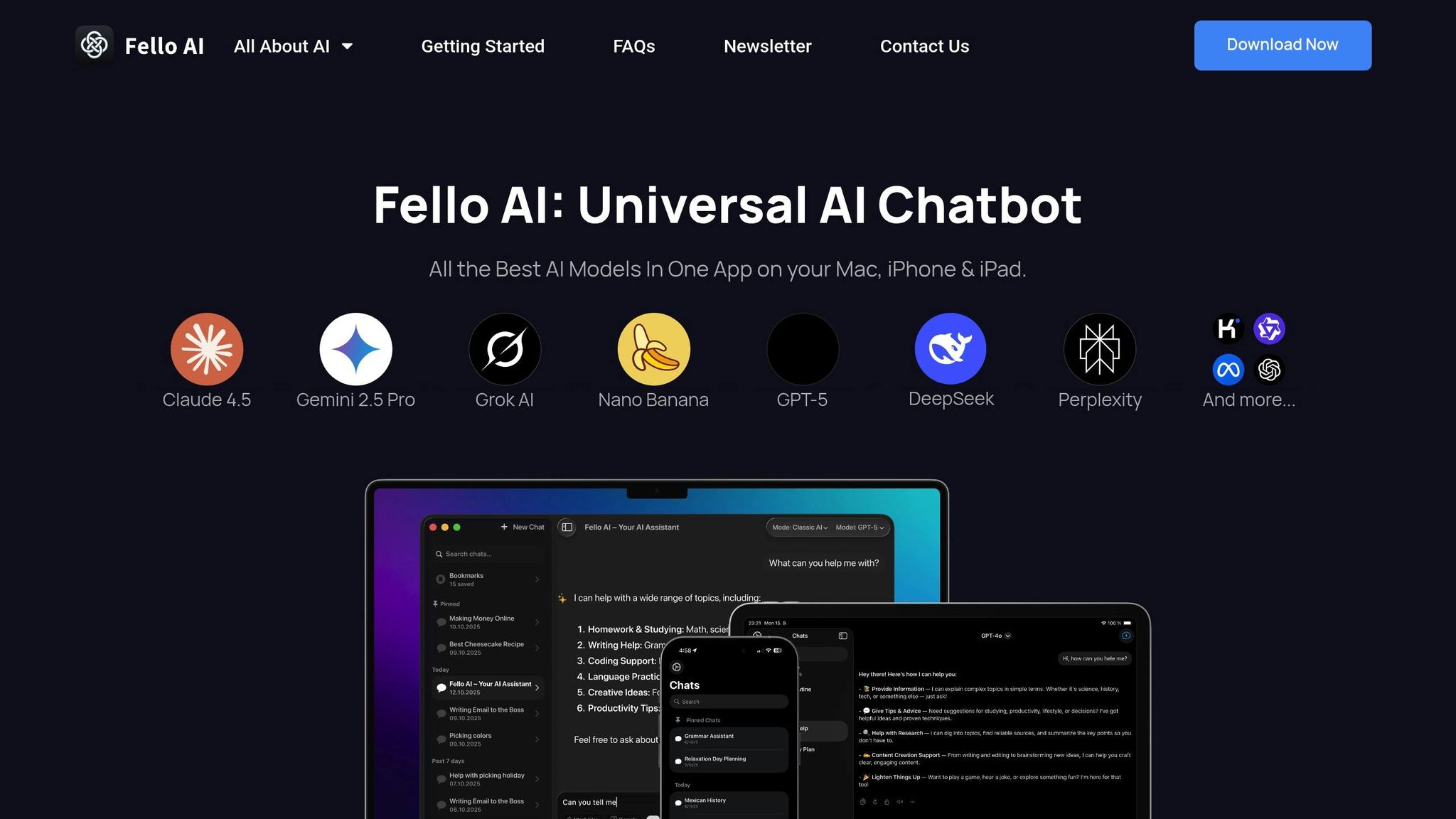
For those who need flexibility, platforms like Fello AI offer access to multiple AI models, including Claude, GPT-5.1, Gemini, Grok, and DeepSeek. This approach allows you to optimize costs by routing simpler tasks to lower-cost models while reserving Claude for more complex problem-solving. Fello AI’s side-by-side model access makes it easy to evaluate which tool best fits your workflow, all without the hassle of managing multiple subscriptions.
Conclusion
When deciding between these AI options, it all comes down to your business needs. Claude 4.5 shines in precision tasks, boasting an 80.9% SWE-bench Verified score and excelling in areas like complex coding and legal analysis, where accuracy is critical. On the other hand, Gemini 3 brings unmatched versatility with its multimodal capabilities, a massive 1-million-token context window, and processing speeds that are 2.6 times faster, making it perfect for research-intensive workflows and handling large-scale operations.
Cost-wise, Gemini 3 Pro is priced at $2.00 per million input tokens, compared to Claude 4.5’s $5.00. This translates to a 52–60% cost reduction for processing large datasets. However, Claude’s HIPAA compliance and robust end-to-end encryption make it worth the extra investment for handling sensitive or regulated data.
For those looking to minimize expenses, adopting a multi-model strategy can reduce AI costs by 40–60%. Platforms like Fello AI make this even easier by offering access to multiple models – including Claude, GPT-5.2, and Gemini – through a single interface, eliminating the hassle of juggling multiple subscriptions.
FAQs
What are the key differences between Claude 4.5 and Gemini 3 for business use?
Claude 4.5 shines in fields requiring advanced reasoning, accurate coding, and thorough analysis. It’s particularly well-suited for industries like legal, compliance, finance, and software development, where precision and careful decision-making are non-negotiable. Its strength lies in managing intricate, multi-step tasks and delivering impressive results in coding benchmarks, making it a reliable option for businesses needing top-tier accuracy.
Gemini 3, by contrast, emphasizes speed, scalability, and multimodal functionality. With a massive 1-million-token context window and the ability to process video and audio, it’s perfect for high-volume, budget-conscious tasks such as document review, customer service, and retail analytics. This makes it an excellent choice for industries that need to process large datasets swiftly and efficiently.
Bottom line: If your focus is on precision and handling complex workflows, Claude 4.5 is the way to go. For tasks requiring speed, scalability, and cost-effective processing, Gemini 3 is the better fit.
How do the costs of Claude 4.5 and Gemini 3 compare for large-scale business projects?
When working on large-scale projects, Claude 4.5 (Opus) often proves to be the more budget-friendly choice compared to Gemini 3 Pro. Here’s why: Claude 4.5 charges $1 USD per 1M input tokens and $5 USD per 1M output tokens, making it roughly half the cost for input and 2.4 times cheaper for output than Gemini 3 Pro, which costs $2 USD per 1M input tokens and $12 USD per 1M output tokens. While Gemini 3 Flash offers a reduced input cost of $0.50 USD per 1M tokens, its higher output fees can still make Claude 4.5 the more economical option for projects that require processing large amounts of output.
On top of that, Claude 4.5 includes a $20 USD/month subscription with advanced enterprise-grade security features, making it an attractive option for businesses handling sensitive information. Meanwhile, Gemini 3 provides a free tier, which might appeal to startups or smaller operations but lacks built-in security tools. For companies managing sensitive data or requiring significant output processing, Claude 4.5 often stands out as the better value. On the other hand, Gemini 3 might be a better fit for tasks that are input-heavy and less demanding in terms of security or output needs.
Which AI is better for businesses working with multiple types of data like text, images, and videos?
For businesses managing a mix of data types like text, images, videos, audio, and code, Gemini stands out as the stronger choice. Built as a multimodal system, Gemini is designed to seamlessly integrate and analyze these formats, making it particularly effective for tasks like advanced image analysis or video understanding. On the other hand, Claude’s abilities in these areas are more restricted.
Independent tests repeatedly highlight Gemini’s superior performance in vision-related tasks and multimodal reasoning. If your business depends on processing and interpreting diverse data formats, Gemini offers a more dependable and capable solution to address your needs.