
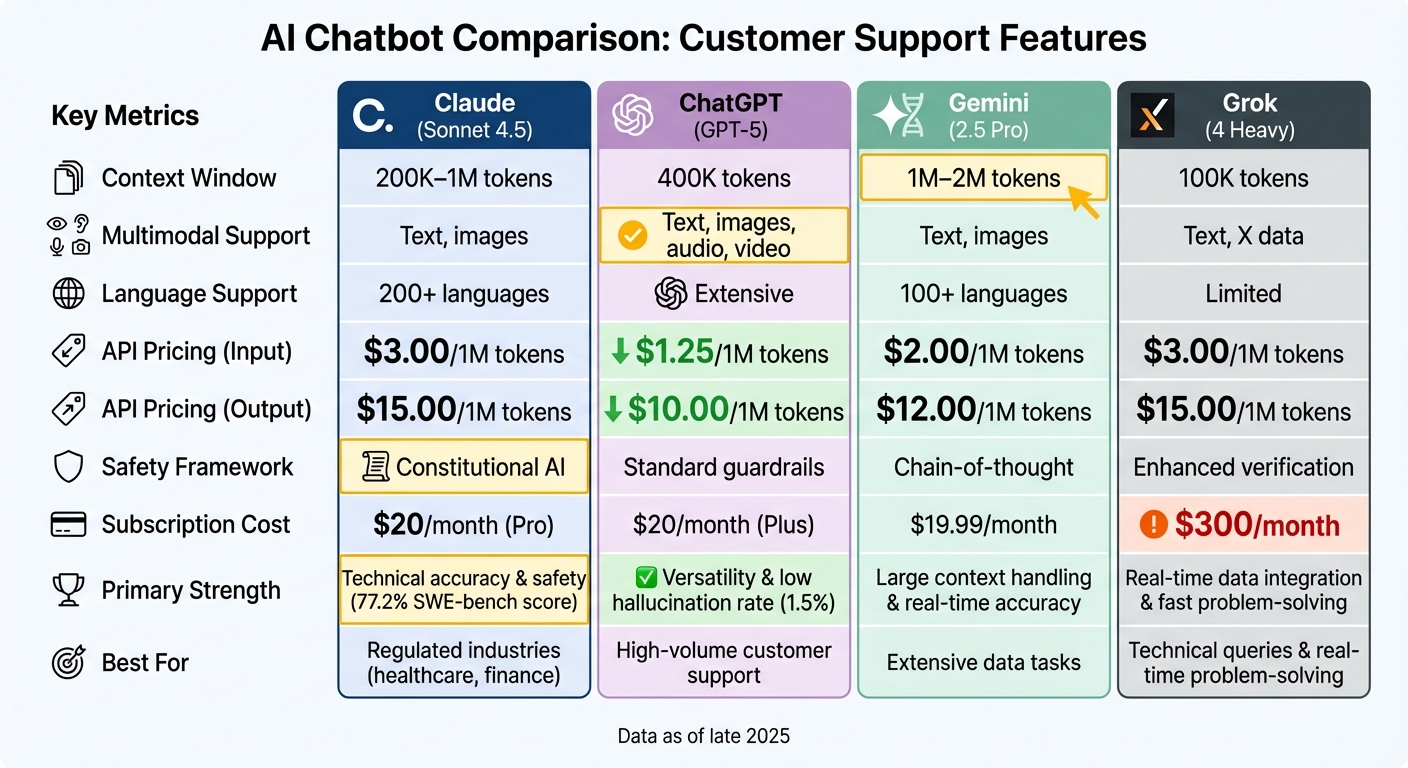
When choosing an AI chatbot for customer support, the decision often comes down to key factors like accuracy, context handling, cost, and compliance. ChatGPT, Claude, Gemini, and Grok each bring strengths suited for different needs:
- ChatGPT (GPT-5): Best for high-volume customer support with lower costs. It has a low hallucination rate (1.5%) and offers multimodal capabilities (text, images, audio, video). Persistent memory improves long-term user engagement.
- Claude (Sonnet 4.5): Ideal for regulated industries like healthcare and finance due to its Constitutional AI framework, which ensures safe and policy-compliant responses. It handles up to 1 million tokens, making it great for complex, context-heavy tasks.
- Gemini (2.5 Pro): Excels in large context handling (up to 2 million tokens for enterprise users) and real-time accuracy via internet access. However, it supports fewer languages than Claude.
- Grok (4 Heavy): Strong in real-time data integration and fast problem-solving with tools like a code interpreter and web browser. It’s better for technical queries but has limited integrations and high subscription costs.
Quick Comparison
| Feature | Claude (Sonnet 4.5) | ChatGPT (GPT-5) | Gemini (2.5 Pro) | Grok (4 Heavy) |
|---|---|---|---|---|
| Context Window | 200K–1M tokens | 400K tokens | 1M–2M tokens | 100K tokens |
| Multimodal Support | Text, images | Text, images, audio, video | Text, images | Text, X data |
| Language Support | 200+ languages | Extensive | 100+ languages | Limited |
| API Pricing (Input) | $3.00/1M tokens | $1.25/1M tokens | $2.00/1M tokens | $3.00/1M tokens |
| API Pricing (Output) | $15.00/1M tokens | $10.00/1M tokens | $12.00/1M tokens | $15.00/1M tokens |
| Safety Framework | Constitutional AI | Standard guardrails | Chain-of-thought | Enhanced verification |
| Subscription Cost | $20/month (Pro) | $20/month (Plus) | $19.99/month | $300/month |
Each chatbot suits different business needs. ChatGPT is cost-effective for general inquiries, while Claude is better for handling sensitive or complex interactions. Gemini’s large token capacity supports extensive data tasks, and Grok excels in real-time technical problem-solving.
AI Chatbot Comparison for Customer Support: Claude vs ChatGPT vs Gemini vs Grok
Claude vs. ChatGPT: Features and Performance
Customer Support Strengths
When it comes to response accuracy, ChatGPT has a clear edge. As of late 2025, GPT-5.2 boasts a hallucination rate of just 1.5%, significantly lower than Claude Opus 4.5‘s 8.7%. This makes ChatGPT particularly effective for high-volume customer support, where precision is paramount. However, there’s more to the story than just accuracy.
Claude takes a different route to ensure reliable responses. Thanks to its Constitutional AI guardrails, it tends to admit uncertainty rather than risk providing incorrect answers. This cautious approach is especially valuable in fields like healthcare or finance, where even small errors can have serious consequences.
Another key distinction lies in how each platform handles context. Claude Sonnet 4.5 offers a massive 200,000-token context window, with a beta option extending up to 1 million tokens – more than double GPT-5’s 400,000-token capacity. This makes Claude ideal for conversations requiring deep context, such as navigating extensive product catalogs or fast document analysis of policy files. On the other hand, ChatGPT offers persistent memory, allowing it to remember user preferences across sessions, which can enhance long-term engagement.
In troubleshooting scenarios, ChatGPT often stands out for its structured and actionable guidance. For instance, in tests, its o3 model identified nine potential causes for a Windows laptop issue and provided a detailed decision tree enhanced by integrated web searches. While Claude Sonnet 4 identified the same number of causes, it lacked the same depth in follow-up troubleshooting steps. These differences highlight how each platform shapes the user experience in unique ways.
Ease of Use and User Engagement
Technical capabilities aside, user engagement paints another layer of distinction between these platforms. According to G2 reviews, Claude scored 92% for understanding and 91% for natural conversation, while ChatGPT earned 89% for understanding and 93% for natural conversation. Overall, ChatGPT holds a higher G2 rating of 4.7 out of 5 stars, compared to Claude’s 4.4.
The tone and communication style further set them apart. Claude is often praised for its empathetic and human-like responses, making it a strong choice for sensitive customer interactions. In contrast, ChatGPT tends to deliver concise and structured replies, which some users describe as occasionally feeling "robotic". Michael Griffiths, Senior Director of Data Science, highlighted Claude’s capabilities:
"Claude fundamentally changes what’s possible in automated customer care. The ability to have nuanced, context-aware conversations through secure enterprise channels opens up entirely new possibilities".
When it comes to costs, both platforms offer standard plans at $20/month and business plans at $25/user/month (billed annually). However, API pricing favors ChatGPT for high-volume operations: GPT-5 charges $1.25 per million input tokens and $10.00 per million output tokens, while Claude Sonnet 4.5 costs $3.00 for input and $15.00 for output.
ChatGPT also takes the lead in multimodal capabilities, supporting text, images, audio, and video. This makes it especially useful for tasks like analyzing screenshots or providing voice-guided support. Claude, while primarily focused on text, offers solid static image interpretation, particularly for documents and charts.
sbb-itb-f73ecc6
Claude vs. Gemini: Context Handling and Multilingual Support

Context Retention and Accuracy
When it comes to processing large volumes of text, Gemini 2.5 Pro handles up to 1 million tokens in its standard configuration and can extend to 2 million for enterprise users. In comparison, Claude 4 supports 200,000 tokens by default, with the option to expand to 1 million tokens in its Sonnet 4.5 version. This difference becomes particularly noticeable when tackling tasks like analyzing lengthy video transcripts or large document sets in a single session.
Despite its smaller token window, Claude is known for its near-perfect recall over thousands of tokens. Anita Kirkovska from Vellum praised its performance, stating:
"Claude 4 Sonnet is the best choice across tasks, with the best balance on speed (1.9s latency) and cost".
Both models excel in adaptive reasoning, effectively integrating new prompt contexts without relying solely on their pre-trained data. Users can optimize these interactions by exploring a Claude 3 AI prompt library for specific support scenarios. However, their approaches to safety and tone differ significantly. Claude’s Constitutional AI ensures a calm, policy-compliant tone, which is especially effective for diffusing tense customer support interactions. On the other hand, Gemini’s more casual tone can occasionally lead to factual inaccuracies, particularly with obscure or niche queries. These distinctions in context handling naturally tie into their multilingual capabilities.
Language Coverage and Accessibility
Language support is another area where these platforms diverge. Claude supports over 200 languages natively, making it an excellent choice for global operations without the need for additional translation workflows. In contrast, Gemini supports over 100 languages, relying on Google’s translation infrastructure for its multilingual capabilities. Anthropic emphasizes Claude’s strength in this area:
"engage in conversations in over 200 languages without the need for separate chatbots or extensive translation processes".
Claude also maintains impressive consistency across languages, achieving about 95–98% of its English performance in widely spoken languages like Spanish, French, and Chinese. It’s even designed to handle code-mixed inputs, which are common in bilingual communities. However, Gemini shows more variability – one study found that its accuracy in English was 84.5% higher than in Polish, suggesting notable gaps in performance across less commonly spoken languages.
Gemini does offer an advantage in real-time accuracy by accessing the internet for up-to-date information. Claude, on the other hand, relies on pre-trained knowledge but proves to be more dependable for analyzing uploaded documents. Pricing also differs between the two: Claude Sonnet 4.5 charges $3.00 per million input tokens and $15.00 for output, while Gemini 3 Pro costs $2.00 for input (200K context) and $12.00 for output.
Claude vs. Grok: Reasoning and Tool Integration
Problem-Solving Features
When it comes to tackling complex customer support challenges, Claude 4.1 and Grok 4 bring distinct methodologies to the table. Claude leans on a hybrid reasoning model, shifting into deeper, step-by-step thinking for intricate problems. This approach ensures users receive structured explanations that guide them through solutions. On the other hand, Grok 4 emphasizes speed and precision, using reinforcement learning and "parallel compute" to evaluate multiple solutions simultaneously.
Performance benchmarks highlight these differences. Claude 4.1 scored 74.5% on the SWE-bench Verified coding benchmark, showcasing its strength in addressing real-world GitHub issues. Meanwhile, Grok 4 Heavy achieved 50.7% on the demanding HLE benchmark and 15.9% on ARC-AGI, nearly doubling Claude Opus 4‘s performance of 8.6%.
Claude’s ability to handle multi-step business logic is a standout feature. As Ashwin Sreenivas, CTO and co-founder, explained:
"Claude is uniquely skilled at understanding and following intricate, multi-step processes with high accuracy. It can navigate the nuanced business logic of each company’s support processes, while catching potential errors before they happen".
Grok, however, shines with its built-in tools, such as a code interpreter and web browser. These features allow it to verify facts in real-time, often delivering more accurate results on the first try for data-intensive queries. These contrasting strengths influence how each platform integrates into customer support workflows.
Tool Integration for Customer Support
The way these platforms integrate with other tools further sets them apart. Claude 4.1 connects seamlessly with major enterprise ecosystems like Amazon Bedrock, Google Cloud Vertex AI, and Databricks. It also supports productivity tools such as Slack, Notion, and Zapier, streamlining support workflows through automation , effectively serving as a virtual assistant for success. In contrast, Grok 4 primarily integrates with the X platform and xAI’s proprietary API, offering built-in internet access for autonomous real-time data retrieval.
For industries where compliance is critical, Claude provides enterprise-grade security certifications, including SOC 2, GDPR, and HIPAA readiness – essential for managing sensitive customer data within CRMs. Grok, at this stage, lacks comparable administrative controls.
Pricing is another area where the two differ significantly. The Claude 4 Opus API pricing is Claude 4 Opus API is priced at $15.00 per million input tokens and $75.00 for output5.00 per million input tokens and $75.00 for output, while Grok 4 API costs approximately $3.00 for input and $15.00 for output. A report from DataStudios summed up the platforms well:
"Claude tends to be extremely thorough and clear in its reasoning process… while Grok is laser-focused on the end result, leveraging searches or calculations to ensure correctness".
Claude vs. Fello AI: Accessibility and Model Switching
Model Switching and Flexibility
Claude and Fello AI take different paths when it comes to offering flexibility. Claude uses a tiered model hierarchy – Opus, Sonnet, and Haiku – so teams can choose based on factors like cost, accuracy, and response time. This setup also supports hybrid reasoning, meaning it can shift between quick answers and more detailed, step-by-step solutions when needed. For example, Claude Sonnet 4.5 is a balanced option, offering both intelligence and cost-efficiency for standard support chats, while Claude Haiku 4.5 focuses on low-latency tasks like retrieval-augmented generation and tool usage.
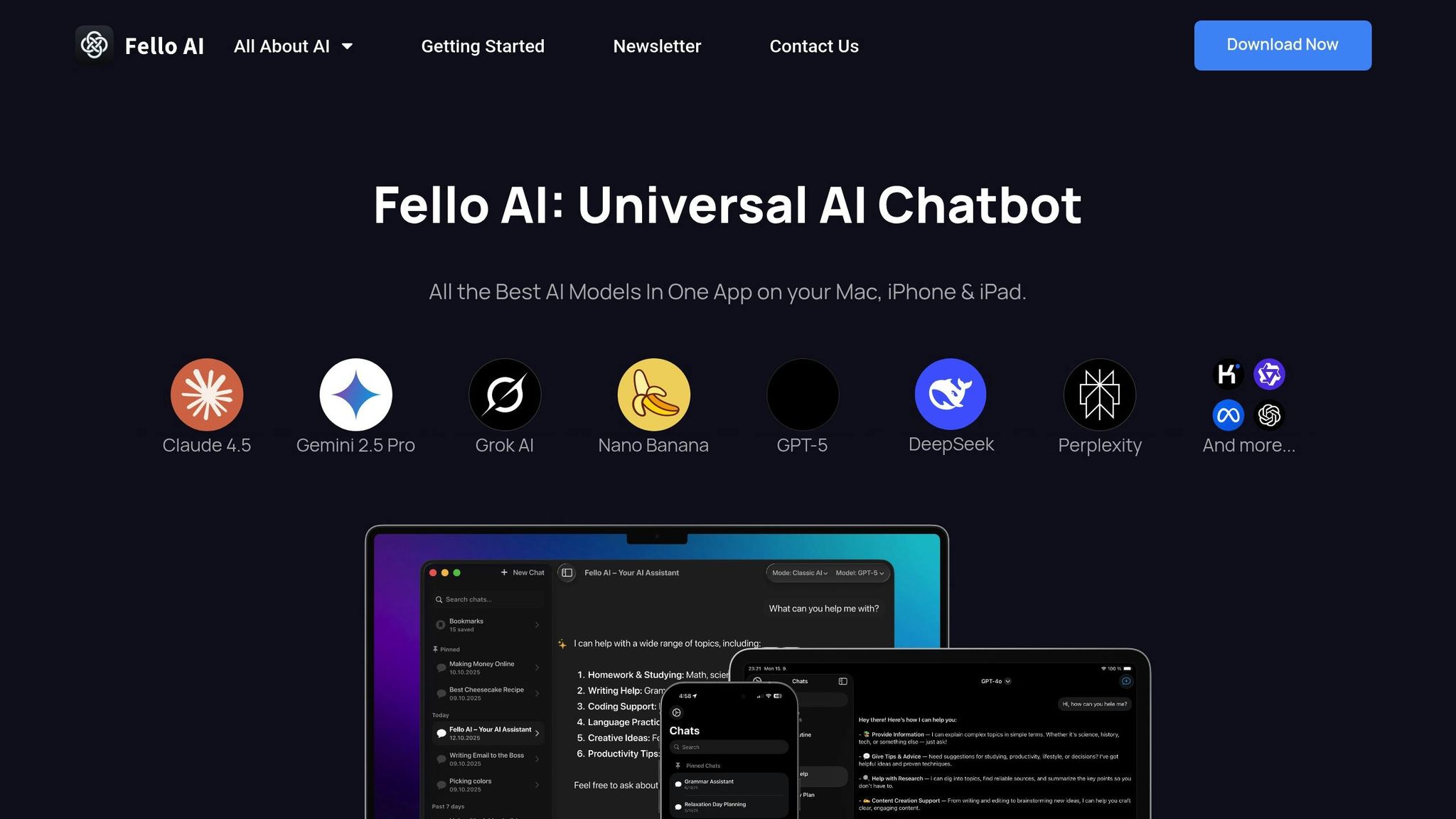
On the other hand, Fello AI takes a multi-model approach by integrating several leading AI models – Claude 4.5, GPT-5, Gemini 2.5, and Grok 4 – into a single interface. This allows support teams to switch between models if one struggles with a particular query. It also enables a tiered strategy: more affordable models handle high-volume FAQs, while premium models tackle complex issues. Fello AI also stands out with its pricing, offering unlimited messaging for $9.99 per month, compared to Claude Pro’s $20 per month.
Claude’s approach is built on its Constitutional AI framework, which ensures a consistent, safe, and policy-compliant tone. In contrast, Fello AI emphasizes adaptability. For instance, if Claude excels in coding support but Grok performs better with real-time news updates, teams can seamlessly switch between them. This ability to adjust models based on query complexity enhances customer support, making it more effective and aligned with specific needs.
Cross-Platform Accessibility
Accessibility is another area where these platforms set themselves apart. Fello AI offers a native app for Apple devices (macOS, iPhone, iPad) built with SwiftUI, ensuring a fast and responsive experience. The app includes handy productivity features like a prompt library for saved responses, full-text search across conversations, and options to pin or bookmark key replies. With a 4.7/5 rating on the Mac App Store and no login required for enhanced privacy, it’s a strong choice for Apple users.
Claude, on the other hand, is primarily accessed through web browsers or via API integrations into professional workflows. These integrations connect Claude with tools like Microsoft Teams, Slack, and Zoom, often through retrieval-augmented generation platforms like Social Intents. This makes Claude a great fit for enterprise environments, especially those needing deep integration with existing CRM and ticketing systems. Additionally, Claude Sonnet 4.5 features a 1,000,000-token context window, allowing it to handle extensive customer histories or entire policy libraries in a single prompt.
For businesses heavily invested in Apple hardware, Fello AI provides immediate and seamless accessibility. Meanwhile, organizations that prioritize enterprise-grade security and compliance – such as SOC 2, GDPR, and HIPAA standards – might lean toward Claude’s API integration and safety-focused design for managing sensitive customer data. Notably, Claude Sonnet 4.5 also excels in technical support, achieving a 77.2% score on SWE-Bench Verified for real-world bug fixes, outperforming competitors in this area.
Comparison Table: Customer Support Metrics
Comparison Table
Here’s a breakdown of key customer support metrics, highlighting the strengths of each chatbot. Claude Sonnet 4.5 stands out for its technical accuracy with a SWE-bench score of 77.2%, ChatGPT delivers 40% higher factual accuracy, and Gemini 2.5 Pro boasts an impressive 1M-token context window, while Claude 3 Opus context window capabilities also support large-scale data processing.
| Feature | Claude (Sonnet 4.5) | ChatGPT (GPT-5) | Gemini (2.5 Pro) | Grok (4 Heavy) |
|---|---|---|---|---|
| Context Window | 200K–1M tokens | 400K tokens | 1M tokens | 100K tokens |
| Primary Strength | Technical accuracy & safety (enhanced by Claude 3.5 Artifacts) | Versatility & empathy | Large context handling | Real-time data integration |
| API Pricing (Input) | $3.00/1M tokens | $1.25/1M tokens | N/A | N/A |
| API Pricing (Output) | $15.00/1M tokens | $10.00/1M tokens | N/A | N/A |
| Subscription Cost | $20/mo (Pro) | $20/mo (Plus) | $19.99/mo (AI Pro) | $300/mo |
| Multimodal Support | Text, image, and audio input | Text, image, voice, video | Text, image, audio, video | Text & X data |
| Safety Framework | Constitutional AI | Standard guardrails | Chain-of-thought reasoning | Enhanced verification |
| Language Support | 200+ languages | Extensive | Moderate | Limited |
| Integration Ease | High (API/Bedrock/Vertex) | High (Plugins/Azure) | High (Google Workspace) | Limited (X/Tesla) |
Each platform has distinct advantages tailored to different needs. For instance, ChatGPT’s lower API pricing makes it ideal for high-volume tasks like handling simple FAQs. On the other hand, Claude’s Constitutional AI framework is a safer choice for industries with strict regulations, such as healthcare or finance.
Grok 4 Heavy offers a unique edge with real-time access to X (formerly Twitter) data and achieves double the performance on certain benchmarks compared to Claude Opus 4, thanks to its multi-agent system. However, this comes with a hefty subscription price of $300/month.
We Automated 80% of Customer Support With One AI Agent (No Code)
Claude’s Strengths in Customer Support
Claude stands out in customer support with its advanced reasoning, excellent memory for context, and strong ethical principles – a blend that makes it ideal for handling sensitive customer interactions.
Thanks to its powerful reasoning engine, Claude goes beyond the limitations of traditional chatbots that rely on pre-programmed answers. It can process complex, multi-step business logic and catch potential mistakes before they escalate. For example, in a typical e-commerce setup, Haiku manages 90% of repetitive inquiries, Sonnet handles 8% of moderately complex disputes, and Opus takes care of the final 2% involving critical or legal issues. This layered approach ensures smooth and reliable customer support, even in high-stakes situations.
Claude’s ability to retain context over long conversations is another key advantage. After its October 2025 memory upgrade, Claude can remember customer preferences across sessions, enabling more personalized and seamless interactions. This eliminates the need for agents or customers to constantly repeat information. Chyngyz Dzhumanazarov, Co-founder and CEO, highlights this benefit:
"Claude Sonnet delivers the best accuracy, which is crucial for our highly sensitive use cases like refunds and cancellations".
The Constitutional AI framework further enhances Claude’s reliability by ensuring it operates ethically in every interaction. Instead of making guesses when uncertain, Claude openly acknowledges its limitations – a critical feature for industries where incorrect information can have serious repercussions. This cautious approach has significantly reduced hallucination rates to 8.7%, far below the industry average of 21.8%. Combined with its ethical safeguards, Claude’s natural conversational style creates a trustworthy and effective support experience.
Speaking of conversational tone, Claude’s genre-aware dialogue feels natural and engaging, steering clear of the robotic vibe often associated with AI. John Wang, Co-founder, shared his thoughts on this:
"Claude performed so well that we’re reevaluating our entire model infrastructure. The reasoning capabilities are significantly better, and the conversational tone feels much more natural even out of the box".
Use Cases and Deployments
Claude’s ability to combine strong reasoning with excellent context retention has made it a go-to tool for enhancing customer support. Businesses in industries like finance, software, and e-commerce are using Claude to handle everything from simple inquiries to intricate policy-related issues. These implementations have led to notable gains in resolution rates and agent efficiency.
Take Coinbase, for example. Between 2024 and 2025, the company integrated Claude into three main systems, including chatbots and tools for support agents. Spearheaded by Senior Engineering Manager Varsha Mahadevan, this rollout now processes thousands of messages per hour across more than 100 regions. It supports millions of users while maintaining a staggering $226 billion in quarterly trading volume. The setup is powered by a multi-cloud infrastructure using AWS Bedrock and Google Vertex AI, ensuring an impressive 99.9999% uptime. Other companies have shared similar success stories, further showcasing Claude’s flexibility and effectiveness.
In customer engagement, Intercom uses Claude to power its Fin AI agent. Serving over 25,000 customers, the platform has achieved an average resolution rate of 51%. Synthesia has also seen remarkable results, resolving over 6,000 conversations and saving more than 1,300 hours, with self-serve support rates reaching 87%. Meanwhile, Fundrise automated more than half of its support volume in just three months, maintaining 95% accuracy and cutting support cases by nearly 50% during high-demand periods.
Another standout example is Lightspeed, which deployed Claude across its global support operations in 2025. The AI now facilitates 99% of customer interactions, helping the company increase daily case closures by 31% and achieve resolution rates as high as 65%. Fergal Reid, VP of AI at Intercom, highlighted the transformative impact of Claude:
"With Claude, we’re not just automating customer service – we’re elevating it to truly human quality. This lets support teams think more strategically about customer experience".
The deployment process is remarkably quick, taking less than an hour with Social Intents. By simply linking Claude API keys and uploading existing documentation, businesses can get started right away. Claude’s Model Context Protocol (MCP) also enables secure integration with tools like Jira, Salesforce, and Slack. On top of that, its Constitutional AI framework streamlines the programming of complex safety rules, saving valuable time.
Choosing the Right AI Chatbot
Factors to Consider
When it comes to selecting the right AI chatbot, it’s all about matching the bot’s capabilities to your specific support needs. One key factor is the context window size: Claude Sonnet 4/4.5 supports up to 1 million tokens, which dwarfs ChatGPT’s 400,000-token capacity. This can make a big difference if your interactions require handling large volumes of data or extended conversations. Another critical consideration is how well the bot integrates with your existing systems.
Cost is another area to evaluate. If you’re managing high-volume FAQ handling, ChatGPT tends to be more budget-friendly. On the other hand, Claude offers pricing structures that cater to industries requiring strict accuracy, such as regulated sectors. Safety and privacy also play a major role. Claude’s Constitutional AI framework provides built-in safeguards to minimize inappropriate responses without requiring extensive manual programming. Additionally, the tone and style of responses differ: Claude leans toward calm, policy-compliant dialogue, while ChatGPT adopts a more conversational and approachable tone.
Aligning AI with Your Support Goals
To make the best choice, start by evaluating how each chatbot aligns with your support goals. Define your ideal customer interaction flow – think about elements like the greeting, response length, and the level of technical detail required. Then, match these needs to each bot’s strengths. For example, you might categorize support tasks into areas like simple FAQ retrieval, multi-step troubleshooting, or real-time account management. In these scenarios, Claude Sonnet 4.5 is a great fit for balanced, versatile support, while Claude Haiku 4.5 excels at low-latency tasks like delivering quick answers.
Each model brings unique strengths to the table, so it’s important to test them in real-world scenarios. Take advantage of free tiers to experiment, and set benchmarks for metrics like accuracy, response speed, cost per interaction, and customer satisfaction. A hybrid approach can also be an effective strategy – for instance, using ChatGPT for general inquiries and Claude for more technical or sensitive tasks. Additionally, implementing streaming APIs to progressively display responses can reduce perceived wait times, creating a smoother customer experience.
Conclusion
Deciding between Anthropic’s Claude and other AI chatbots ultimately depends on aligning each platform’s strengths with your specific needs. Claude stands out in areas like technical troubleshooting and high-stakes interactions, thanks to its Constitutional AI framework and an impressive 80.9% SWE-bench coding accuracy. This makes it a strong choice for IT helpdesks, log analysis, and industries with strict regulations. As Chyngyz Dzhumanazarov, Co-founder and CEO, explains:
"Claude Sonnet delivers the best accuracy, which is crucial for our highly sensitive use cases like refunds and cancellations".
Meanwhile, ChatGPT shines in handling high-volume customer interactions with a focus on empathy and conversational warmth. Its competitive API pricing and extensive integration options make it a go-to for businesses prioritizing cost-efficiency and customer engagement. Features like multimodal support and advanced automation tools further enhance its appeal.
Many businesses are finding success by adopting a hybrid approach – using ChatGPT for general, high-volume inquiries and Claude for more complex or sensitive tasks. This strategy allows companies to capitalize on the strengths of both platforms, balancing cost and performance effectively.
As both platforms continue to evolve, with advancements like extended thinking modes and agentic workflows, integrating Retrieval-Augmented Generation (RAG) to train chatbots on specific knowledge bases can significantly reduce errors and improve accuracy. Ultimately, the best choice will depend on how well the chatbot aligns with your support goals and customer expectations.
FAQs
How does Claude’s Constitutional AI help industries with strict regulations?
Claude’s Constitutional AI framework is built to prioritize safe, honest, and dependable outputs by integrating a set of guiding principles directly into the model itself. This internal safety mechanism helps automatically screen out inappropriate content, bias, and misinformation. This makes it especially useful in fields like finance, healthcare, and legal services, where strict regulatory compliance is a must.
By following clearly defined rules, Claude provides responses that are more consistent and aligned with regulations such as GDPR, HIPAA, and FINRA. This not only reduces compliance risks but also simplifies auditing processes. Businesses can expand automated customer support without compromising on ethical standards or regulatory requirements, making operations smoother and more reliable.
How does Claude handle conversation context compared to other AI chatbots?
Claude shines when it comes to handling conversations with ease and depth, effortlessly keeping track of context across multiple exchanges. It can recall earlier messages, piece together information, and align with a brand’s tone – all without needing the entire chat history to be reloaded. This makes it a standout choice for managing high-demand customer support.
On the other hand, many AI chatbots, such as ChatGPT, often rely on extra tools or manual configurations to maintain context. This can sometimes lead to inconsistencies or missed details. Claude’s ability to retain context seamlessly ensures smoother, more logical responses and quicker solutions, even in repetitive or more challenging support situations.
Why would a business use both Claude and ChatGPT for customer support?
Businesses might choose to combine Claude and ChatGPT for customer support because each brings unique strengths to the table. Claude shines in managing complex, context-rich tasks. Its empathetic tone, strong reasoning skills, and ability to process long conversations make it perfect for handling detailed queries that require a consistent brand voice, a deep understanding of policies, or multi-step problem-solving.
Meanwhile, ChatGPT is known for its quick response times, seamless integrations, and extensive general knowledge. This makes it a great fit for handling straightforward, high-volume questions or tasks that rely on third-party tools. By leveraging both systems, companies can tackle intricate issues with precision while efficiently managing simpler inquiries. Plus, having both ensures continuity – offering a backup during downtime or pricing changes – so businesses can deliver dependable 24/7 support.