
Claude AI is designed for complex reasoning tasks, making it a strong choice for professionals in fields like law, finance, and healthcare. Its standout features include the ability to process up to 200,000 tokens per interaction, modular Claude Skills for organization-specific tasks, and seamless integration with platforms like Google Workspace and Jira. These capabilities enable Claude to handle extensive documents, cross-reference details, and provide structured outputs for compliance and governance needs.
Key Features at a Glance:
- Long Context Retention: Handles up to 200,000 tokens, maintaining logical flow across lengthy documents or conversations.
- Enterprise Tools: Offers customizable instruction sets (Claude Skills) for tasks like financial reporting or compliance checks.
- Deep Research Mode: Quickly analyzes and synthesizes data from connected platforms like Google Workspace.
- Integration: Works with tools like Jira, Confluence, and Zapier for streamlined workflows.
- Reasoning Abilities: Uses step-by-step problem-solving for accurate and logical outputs.
While Claude excels in handling large-scale, text-based tasks, it requires careful prompt structuring for optimal performance and performs best in English. Its features make it a reliable choice for regulated industries and knowledge-intensive workflows.
1. Claude AI

Reasoning Capabilities
Claude’s reasoning abilities go beyond simply generating text – it methodically works through problems step by step. Using a "chain-of-thought" approach, Claude breaks down complex questions into manageable steps, ensuring precise and logical answers. This makes it a strong choice for tasks that demand accuracy, like analyzing legal contracts, reviewing financial models, or synthesizing scientific research. For instance, when handling a detailed technical report, Claude can summarize key insights, compare sections, and answer follow-up questions – all while maintaining consistency. Importantly, Claude bases its responses strictly on the data provided.
Anthropic’s latest models, including Claude 3.7 Sonnet, are described as "enhanced reasoning models" that surpass earlier versions in following instructions, solving complex problems, handling multimodal tasks, and coding. Independent reviews highlight Claude’s ability to deliver fluent, coherent answers with minimal errors, making it a dependable choice for professionals, researchers, and technical teams.
Context Window Size
Claude 3 supports an impressive context window of up to 100,000 tokens – enough to process lengthy, multi-page documents. This capability allows Claude to analyze extensive materials without losing accuracy or clarity. It can also handle multiple related documents simultaneously, cross-referencing details, spotting patterns, and creating thorough analyses. This feature is especially useful for researchers, analysts, and technical teams managing complex workflows that involve large volumes of information.
Enterprise Features
Claude is designed for structured and repeatable reasoning, making it ideal for professional use rather than casual interactions. Its Claude Skills – customizable instruction sets tailored to tasks like financial reporting, compliance checks, or brand-specific content creation – help organizations standardize their outputs and reduce inconsistencies caused by ad-hoc prompts. Additionally, Claude prioritizes safety, alignment with user needs, and transparency, making it a strong fit for regulated industries like finance, healthcare, and legal services. Features like policy-aware behavior, explainable outputs, and restricted data access ensure auditability and governance, which are critical for enterprise applications.
Integration Flexibility
Claude integrates seamlessly with platforms like Google Workspace, Jira, Confluence, and Zapier, enabling it to pull from internal documents and project data for detailed analyses. This transforms Claude into more than just an assistant – it becomes a reasoning layer that works across an organization’s data ecosystem. For example, a strategy team could use Claude to analyze a folder of market research, customer feedback, and competitor data, extracting key metrics and producing a well-structured report. Its deep research mode supports extended information synthesis across connected platforms, with sessions lasting from 5 to 45 minutes. Developers can also leverage Claude through API access or cloud services like AWS Bedrock to build custom applications that incorporate its reasoning capabilities.
These advanced reasoning and integration features set the stage for comparing Claude AI with Fello AI’s multi-model approach in the following section.
Building an agent with Claude 3.7, Anthropic‘s new reasoning model
2. Fello AI
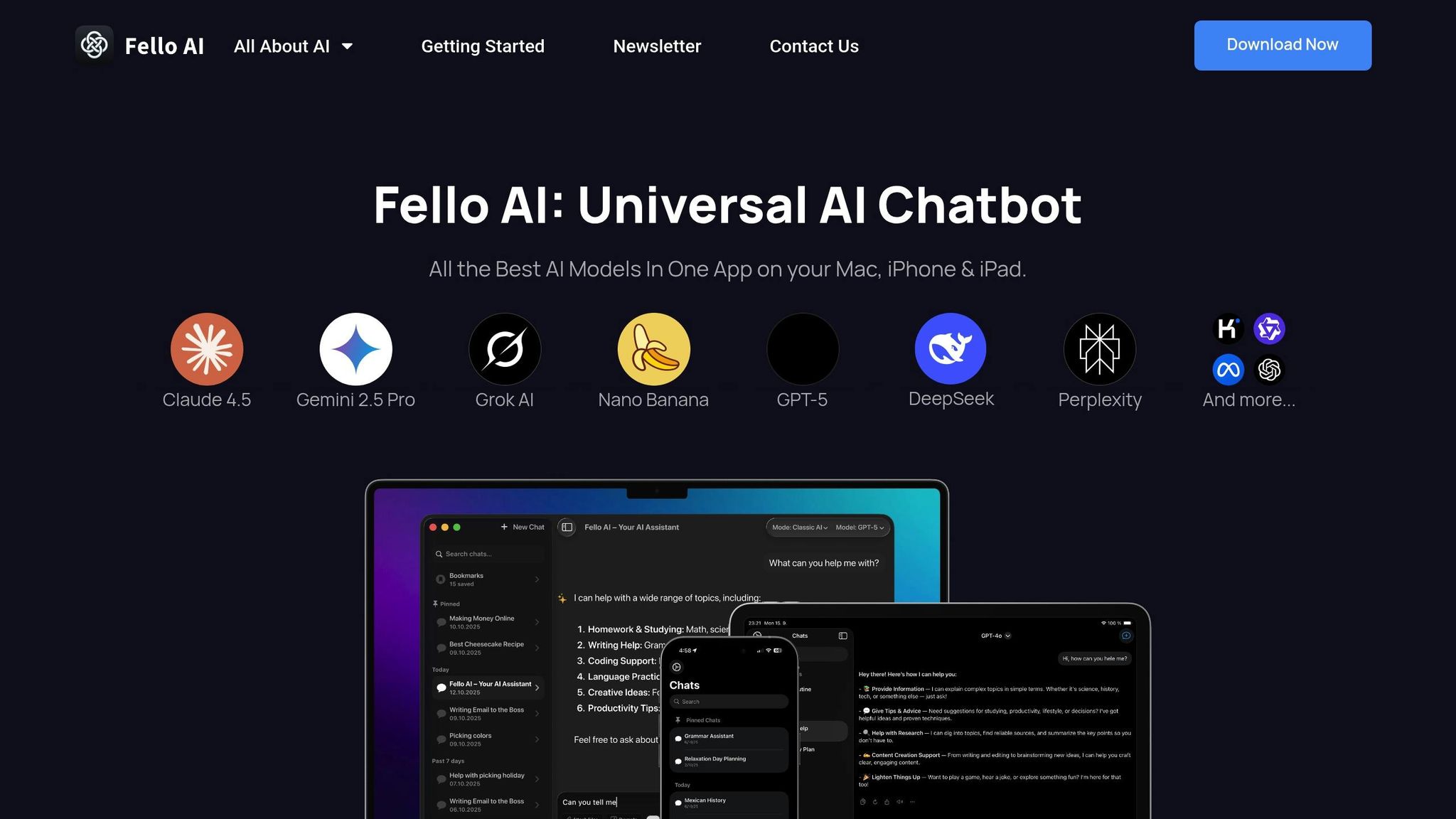
Fello AI currently falls short when it comes to providing clear and verifiable information about its reasoning capabilities, enterprise features, and integration options. Unlike established platforms such as Anthropic’s Claude (source), there’s a noticeable lack of accessible details about its technical specifications, architecture, training methods, deployment strategies, or practical use cases. This makes it difficult to assess its performance or reliability in comparison to more transparent alternatives.
When choosing AI solutions, it’s essential to prioritize platforms with well-documented features, proven performance metrics, and clear security protocols. Without concrete details on Fello AI’s capabilities, organizations should approach its use in critical applications with a high degree of caution.
sbb-itb-f73ecc6
Pros and Cons
When comparing Claude AI and Fello AI, notable differences emerge in areas like documentation, performance, and enterprise integration. Here’s a breakdown of their strengths and limitations:
| Criteria | Claude AI | Fello AI |
|---|---|---|
| Documentation & Transparency | Provides detailed technical specifications, architecture insights, and performance benchmarks, helping organizations understand its design and deployment. | Limited publicly available information on capabilities and technical details. |
| Context Window | Handles up to 200,000 tokens (around 350 pages of text per interaction), ideal for processing extensive documents. | No verifiable information available. |
| Reasoning Capabilities | Excels in multi-step reasoning with an extended thinking mode (lasting 5–45 minutes for complex tasks) and offers structured explanations for intricate queries [2, 5]. | Reasoning methodology and performance metrics are unclear. |
| Enterprise Features | Includes a modular Skills system for creating standardized instruction sets and integrates with tools like Google Workspace, Jira, Confluence, and Zapier. | No documented enterprise features or integration options. |
| Safety & Compliance | Designed with ethical principles and a text-first, explainable approach, making it suitable for compliance-focused industries [2, 4]. | Safety protocols and compliance features are not documented. |
| Multilingual Support | Processes multiple languages but performs best in English. | Language capabilities are unspecified. |
| Governance & Auditability | Offers high auditability through Skills versioning and policy linking, allowing compliance officers to efficiently review shared modules. | Governance features are unclear. |
| Learning Curve | Requires familiarity with prompt engineering to optimize capabilities, as response quality can vary based on query formulation. | User experience requirements are largely unknown. |
| Response Consistency | Responses may sometimes be overly summarized or too detailed, depending on the prompt. | No documented information on response consistency. |
| Multimodal Capabilities | Can interpret handwritten notes and simple charts (as seen in Claude 3.5 Sonnet), though primarily text-focused with limited image processing. | Visual processing capabilities are unspecified. |
Key Takeaways
Claude AI stands out for its comprehensive documentation and transparency, particularly beneficial for enterprise users. Its Skills system allows organizations to create task-specific instruction sets, such as financial reporting modules that include ratio calculations and IFRS terminology or marketing guidelines that ensure brand consistency. This modular design also enhances auditability, enabling compliance officers to review shared instruction sets instead of sifting through countless individual prompts.
However, Claude AI does come with challenges. Crafting effective prompts is crucial, as poorly structured queries can result in responses that are either too brief or overly detailed. Additionally, while its performance in English is strong, its capabilities in other languages are less reliable.
Another major advantage is Claude’s integration with tools like Google Workspace, Jira, Confluence, and Zapier. This connectivity helps break down traditional data silos, streamlining workflows across different platforms. Its text-first approach, combined with explainable and editable responses, makes it particularly appealing for compliance-driven sectors.
Claude AI also excels in handling complex analytical tasks. Its extended analysis sessions, which can last from 5 to 45 minutes, enable deep dives into research and problem-solving. This makes it a powerful tool for strategic decision-making, where careful consideration of multiple variables is essential. Despite the longer processing times, this capability can save significant time compared to traditional methods.
These features make Claude AI a strong contender for enterprises seeking robust reasoning and compliance capabilities, though it requires thoughtful prompt engineering to unlock its full potential. Fello AI, on the other hand, lacks the transparency and feature set needed to compete effectively in these areas.
Conclusion
Claude AI stands out as a strong contender for knowledge-based reasoning, offering reliable and transparent capabilities for tackling complex analytical tasks. On the other hand, Fello AI lacks sufficient documentation, making it harder to assess its professional applicability.
Claude’s standout features make it particularly appealing for organizations dealing with intricate workflows. Its ability to handle extensive context, the modular Skills system, and a dedicated deep research mode allow for efficient and traceable solutions. The Skills system is especially useful for teams aiming for consistency – financial analysts, for instance, can embed IFRS frameworks, while legal teams can enforce citation standards seamlessly.
For industries heavily focused on compliance, Claude’s explainable, text-first approach meets regulatory expectations. Its auditability and compliance features are well-suited for sectors like finance, healthcare, and legal services, where governance is a top priority.
The deep research mode is another highlight, synthesizing data quickly to generate well-structured reports. These extended analysis sessions serve as a valuable resource for strategic decision-making. However, it’s worth noting that effective prompt engineering plays a critical role in maximizing Claude’s performance, as the structure of queries significantly influences the quality of responses. While Claude excels in English, its capabilities in other languages are less developed.
Organizations in regulated industries, as well as researchers, technical writers, and professionals tackling multi-step problems, will find Claude particularly useful. Teams already using tools like Google Workspace, Jira, Confluence, or Zapier can benefit from its existing integrations. However, those needing extensive customization or stronger multilingual support might want to consider other options. Additionally, organizations without the resources to develop effective prompting strategies may encounter a steeper learning curve.
With its combination of transparent reasoning, deep analytical capabilities, and seamless enterprise integration, Claude AI offers a powerful solution for professionals handling complex knowledge-driven challenges. It has the potential to redefine how teams approach intricate problem-solving in today’s fast-paced professional landscape.
FAQs
How does Claude AI’s ability to retain long context help professionals in fields like finance and healthcare?
Claude AI’s ability to retain and reference large amounts of information during conversations is a game-changer for professionals in fields like finance and healthcare. By handling extensive datasets and keeping track of complex cases, it ensures smoother workflows and consistent progress, even in intricate scenarios.
This feature not only simplifies processes but also minimizes mistakes and supports more precise, data-backed decisions. For industries dealing with high-stakes responsibilities, it’s an essential tool for staying efficient and accurate.
What are Claude’s skills, and how can they be tailored to meet specific organizational needs?
Claude stands out for its ability to handle advanced language tasks, engage in detailed reasoning, and carry out practical operations. These strengths make it suitable for tackling specific business challenges, like automating workflows, analyzing intricate datasets, or offering meaningful recommendations.
What sets Claude apart is its ability to be fine-tuned to match the unique needs of your organization. By tailoring its capabilities, you can ensure it delivers precise and relevant outcomes. This flexibility makes Claude a valuable asset for businesses looking for AI solutions tailored to their goals.
How does Claude AI support compliance and transparency in regulated industries?
Claude AI is designed to support compliance and transparency in regulated industries by using constitutional AI to adhere to ethical standards. It includes strong accountability features and delivers clear, explainable reasoning to make audits straightforward. On top of that, Claude is continuously monitored to identify and mitigate biases or unintended consequences, ensuring it aligns with the strict demands of regulated sectors.