
Claude Opus 4.5, released on November 24, 2025, is Anthropic‘s latest AI model, designed to handle complex reasoning, coding, and autonomous tasks. It introduces adjustable effort settings (high, medium, low) for tailored performance, a zoom tool for detailed interface inspection, and enhanced memory for maintaining context in long projects. Accessible via web and mobile, it’s available under Max and Pro plans.
Key highlights:
- Effort Parameter: Adjust performance for speed or depth.
- Zoom Tool: Analyze specific screen areas for precision tasks.
- Improved Memory: Manage extended conversations seamlessly.
- Advanced Coding & Agents: Optimized for developers and enterprises.
Anthropic also offers Sonnet 4.5 (balanced performance) and Haiku 4.5 (speed-focused) alongside Opus 4.5, ensuring solutions for diverse needs. This release reflects Anthropic’s focus on refining AI tools for professional and enterprise use.
New Claude Opus 4.5 Full Breakdown & Real World Use Cases
Key Features of Claude Opus 4.5
Claude Opus 4.5 brings a series of updates that elevate AI-powered workflows to new levels. These improvements give users greater control over performance, better manage extended conversations, and enhance autonomous task handling.
Improved Intelligence and Reasoning
With the effort parameter now defaulting to high, Claude Opus 4.5 delivers deeper reasoning capabilities while offering adjustable speed settings. Users can switch to medium or low effort when faster responses are needed, striking a balance between speed and quality. For example, a development team might choose high-effort mode for tackling complex debugging tasks and switch to medium for routine code reviews.
Anthropic has positioned Opus 4.5 as its leading model for coding, AI agents, and tackling intricate reasoning challenges. Compared to Claude Opus 4.1, which launched on August 5, 2025, this version steps up with enhanced reasoning abilities, making it especially valuable for enterprises that require robust problem-solving and reliable code generation. These reasoning upgrades work in tandem with the model’s improved memory, ensuring it can handle extended and complex tasks without losing context.
Enhanced Memory and Long-Context Abilities
The memory upgrades in Claude Opus 4.5, introduced for Max plan users in October 2025 and later extended to Pro plans, allow the model to maintain context over lengthy conversations and workflows. This means users can seamlessly continue projects across multiple sessions. For instance, a consultant could build on earlier discussions without needing to reintroduce prior details, saving time and improving efficiency.
Advanced Autonomous Operations
New interface tools in Opus 4.5 further refine autonomous operations. A standout addition is the zoom tool, which lets the model request close-up views of specific screen areas for detailed analysis. This feature is particularly useful for multi-step workflows, enabling precise inspection of interface elements, error messages, or data visualizations during critical moments. By enhancing autonomous operations, Opus 4.5 minimizes the need for manual input, streamlining high-volume tasks and ensuring smoother workflows.
Practical Applications of Claude Opus 4.5
Claude Opus 4.5 brings a range of practical benefits across industries, offering advanced reasoning, memory, and autonomous capabilities. These features help organizations simplify workflows and address challenges that once required significant human effort.
Enterprise and Office Solutions
Claude Opus 4.5 shines in enterprise environments, where its enhanced reasoning and memory are put to good use.
Contract review and analysis is a standout application. The model can thoroughly examine legal documents, flagging potential issues, inconsistencies, or areas that need attention. Legal teams can expedite their workflows by applying high-effort settings for critical agreements and medium effort for routine reviews.
Compliance risk detection is another area where Opus 4.5 excels. It can automatically scan documents, policies, and communications for regulatory violations, analyze contracts for compliance clauses, and monitor internal communications for potential risks. Adjusting the effort parameter allows businesses to focus high-effort reviews on critical compliance tasks while using lower settings for routine checks, balancing accuracy and cost.
Research synthesis becomes faster and more effective with Opus 4.5. The model can process large volumes of research material, identify patterns, and create clear, contextual summaries. This helps researchers, academics, and analysts speed up literature reviews, pinpoint research gaps, and conduct in-depth analysis of complex topics.
Project management support benefits from the model’s ability to analyze project data and maintain context across long discussions. Teams can use it to identify bottlenecks, generate detailed reports, and streamline strategic planning. Its improved memory ensures that past discussions and decisions are seamlessly incorporated into ongoing project workflows.
Creative and Development Use Cases
Beyond office tasks, Claude Opus 4.5 empowers developers and creative professionals with its advanced capabilities.
Anthropic describes it as the best model in the world for coding and agents, making it a valuable tool for technical professionals. Its enhanced zoom tool, which provides detailed interface analysis, supports sophisticated autonomous operations and agent development.
Code generation and debugging are more efficient with Opus 4.5. Developers can rely on the model for solving complex coding challenges and producing reliable code. The zoom tool aids in debugging by allowing precise examination of interface elements, error messages, or data visualizations, reducing manual effort and speeding up development.
Content generation is another area where Opus 4.5 proves valuable. Writers, marketers, and creatives can use it for long-form content creation, ensuring narrative consistency, or for crafting marketing copy with nuanced messaging. It even assists with creative writing, such as developing intricate plots. High-effort settings are ideal for producing polished, high-quality content, while medium effort works well for brainstorming and ideation.
Agent development is simplified with Opus 4.5’s advanced autonomy. Developers can create agents capable of performing multi-step tasks with better visual understanding and interaction. The zoom tool supports practical applications like automated UI testing, accessibility automation, and extracting data from visual documents or screenshots.
High-Volume Deployment Scenarios
The effort parameter makes Opus 4.5 a cost-effective solution for handling large-scale tasks. Businesses can set it to lower effort for routine tasks, reducing costs and response times, while reserving high-effort processing for complex challenges that require maximum reasoning power.
Document analysis at scale is a prime example of this flexibility. Routine tasks can be assigned to lower effort settings, optimizing costs and speed, while high-effort analysis is used for more intricate cases, ensuring both efficiency and accuracy.
Quality assurance and testing processes also benefit from Opus 4.5’s enhanced capabilities. The model can systematically test software interfaces, identify issues, and generate detailed reports. Its zoom tool allows for precise inspection of UI elements, making it a reliable asset for maintaining high standards in large-scale software systems or digital products.
sbb-itb-f73ecc6
Model Variants and Pricing
Anthropic has introduced a range of Claude 4.5 models, each designed to cater to specific needs and budgets. These tailored options allow users to select the model that aligns best with their requirements.
Claude Opus 4.5: Advanced Intelligence
Released on November 24, 2025, Claude Opus 4.5 represents Anthropic’s most advanced model. It enhances reasoning, coding, and problem-solving capabilities while adding features like a zoom function for detailed screen inspections. The model also maintains context seamlessly across conversation turns. With adjustable effort modes – high, medium, or low – it offers flexibility for detailed analysis, balanced outputs, or token-efficient automation. Testing shows that Opus 4.5 significantly reduces token usage, cutting task times from two hours to about 30 minutes, while also being more affordable than earlier Opus versions. Each Claude 4.5 model includes a 200,000-token context window and a 64,000-token output limit.
Claude Sonnet 4.5: Creativity and Independence
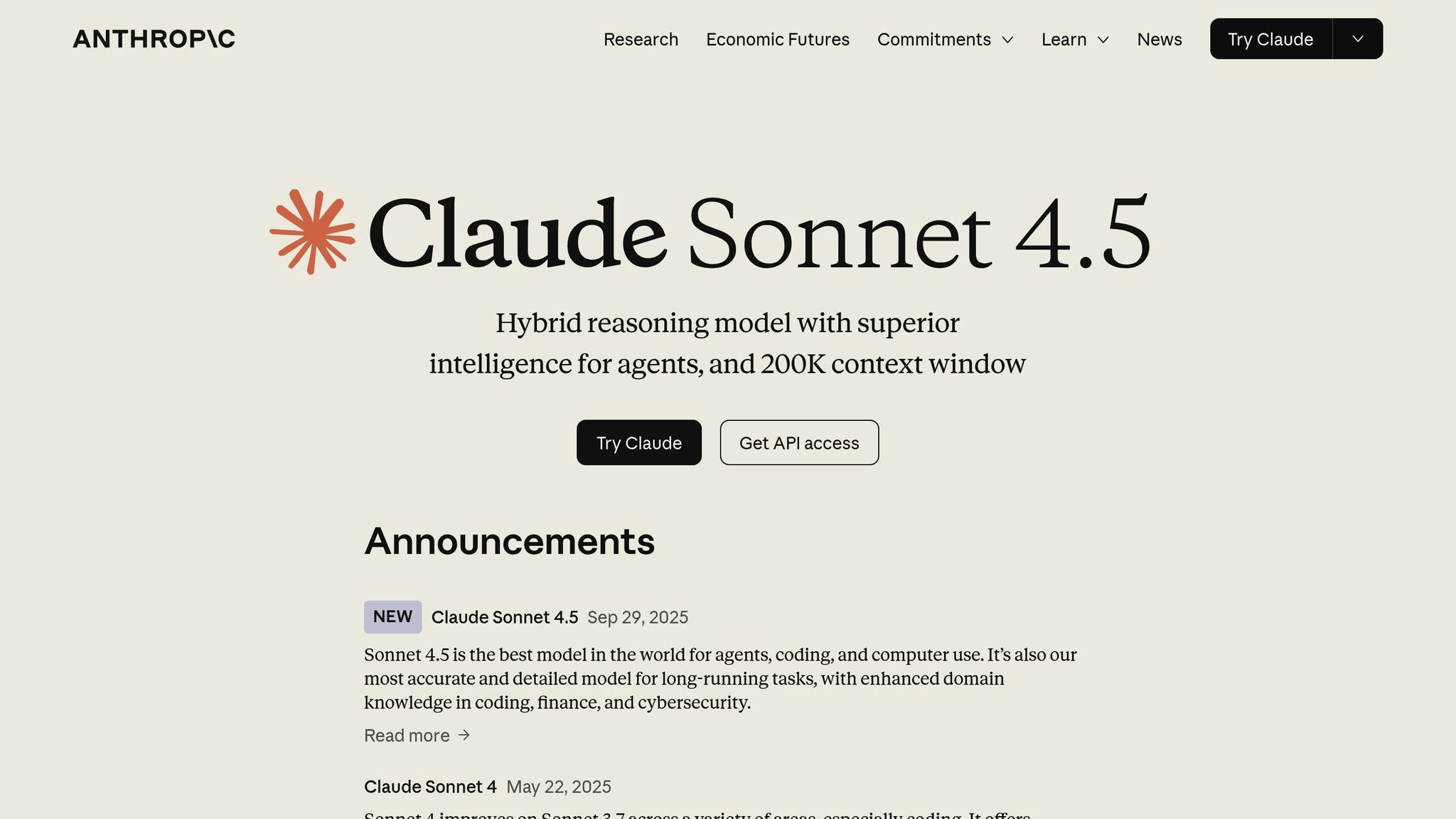
Released on September 29, 2025, Claude Sonnet 4.5 is ideal for complex agents and coding tasks. Anthropic describes it as "the best model in the world for real-world agents, coding, and computer use". It offers enhanced autonomy, allowing it to independently work on tasks for extended periods while providing updates on its progress. With improved context tracking, Sonnet 4.5 optimizes token usage and prioritizes tasks effectively. It’s also a standout for creative projects, excelling in tasks like crafting presentations and animations, often producing polished, professional results. The standard context window is 200,000 tokens, with an optional beta version offering a 1-million-token window. For those who prioritize speed and cost savings, Claude Haiku 4.5 is another option worth considering.
Claude Haiku 4.5: Speed and Affordability
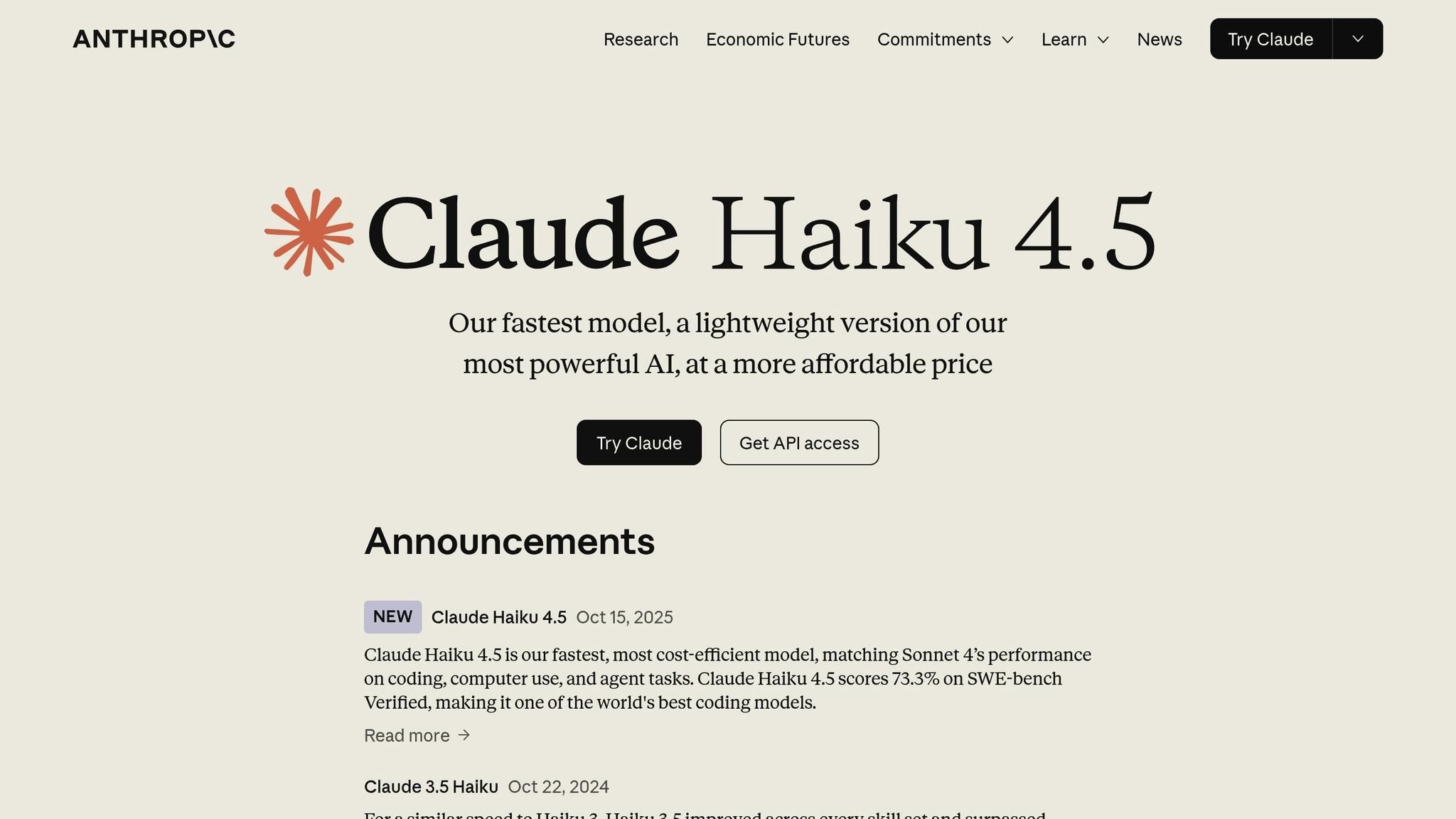
Claude Haiku 4.5 focuses on delivering fast, cost-efficient performance without compromising on intelligence. It matches Sonnet 4’s capabilities in reasoning, coding, and complex tasks. Thanks to optimized token processing, Haiku 4.5 operates at more than twice the speed of Sonnet 4 and is available at roughly one-third of the cost. This makes it an excellent choice for high-volume deployments and coding automation. Its combination of speed, efficiency, and affordability is ideal for organizations aiming to scale their AI use without significant infrastructure expenses. Additionally, all Claude 4.5 models allow seamless transitions between versions, enabling users to switch from Claude Opus 4.1 to Sonnet 4.5 or Opus 4.5 without modifying their code.
How Claude Opus 4.5 Compares to Competitors
Claude Opus 4.5 steps into a highly competitive field of advanced AI models, giving users plenty to consider when choosing the right tool for their needs.
Performance Benchmarks
Anthropic describes Claude Opus 4.5 as its most advanced model yet. This version builds on prior updates, showcasing improvements in reasoning, analysis, and creative tasks. While direct benchmark comparisons with models like GPT 5.1 or Gemini 3 haven’t been made public, Anthropic’s quick update cycles suggest a strong focus on staying competitive.
One standout feature is the effort parameter, which allows users to control processing intensity. This flexibility lets users adjust the model’s performance based on their needs, balancing speed and depth in ways that competitors often don’t offer. For instance, users can prioritize faster responses for simpler tasks or dial up the effort for more detailed and complex analyses.
Additionally, the model includes a zoom tool that enhances its ability to interact with visual interfaces. This feature lets Claude Opus 4.5 request magnified views of specific screen areas, making it more effective at navigating and analyzing visuals. Whether for UI testing or automation workflows, this capability adds precision to tasks requiring detailed visual comprehension.
These features not only improve the model’s raw performance but also give it unique strengths that set it apart in the market.
Competitive Differences
The effort parameter is a key differentiator, offering a level of customization that many competitors lack. For enterprise teams managing high-volume operations, low-effort settings can provide faster and more economical responses. Meanwhile, researchers or analysts can use high-effort settings for in-depth, complex tasks, tailoring the model’s performance to their specific needs.
Anthropic also takes a broader approach with its ecosystem strategy, offering a tiered system of models tailored to different use cases. Alongside Opus 4.5, there’s Sonnet 4.5 for coding and agents and Haiku 4.5 for speed and affordability. This tiered offering allows users to choose the best tool for each task and switch between models seamlessly, without requiring additional integration work. In contrast, some competitors provide fewer options or require significant adjustments when shifting between models.
The zoom tool further enhances Claude Opus 4.5’s capabilities in visual tasks. By requesting close-up views of specific screen areas, the model can better interpret and interact with screen-based interfaces. This is particularly useful for tasks like UI testing, automation, or any workflow needing precise visual input.
Another advantage is Anthropic’s commitment to frequent updates. With major releases every few months, users benefit from continuous improvements and quick responses to industry advancements. This rapid iteration ensures the model remains competitive without long waits between updates.
Beyond performance, Claude Opus 4.5 integrates seamlessly into various platforms. Tools like Claude for Excel, mobile apps for iOS and Android, and other integrations make the model accessible across different workflows. This ease of use adds practical value, allowing users to incorporate the model into their daily tasks effortlessly.
Cost efficiency is another area where Claude Opus 4.5 shines. The adjustable effort settings give users control over token usage and processing time, helping to reduce costs for tasks that don’t require the model’s full capabilities. For organizations running the model at scale, this flexibility can lead to noticeable savings, especially compared to models with fixed performance levels.
Conclusion
Claude Opus 4.5 takes Anthropic’s AI capabilities to the next level, building on previous versions with improvements in reasoning, interface tools, and performance controls. Released on November 24, 2025, this model is designed to meet the needs of organizations tackling advanced coding challenges, autonomous agent operations, and complex analytical tasks.
One standout feature is the effort parameter, which gives users control over processing intensity. Teams can opt for medium or low effort to prioritize speed, while reserving high effort for more demanding tasks. This flexibility helps organizations manage resources and costs more effectively, particularly when deploying AI at scale.
Another key tool, the zoom feature, enhances precision in UI testing and automation by allowing users to magnify specific screen areas.
Anthropic offers a tiered lineup to cater to different needs: Opus 4.5 for maximum intelligence, Sonnet 4.5 for balanced performance, and Haiku 4.5 for speed. This structure ensures organizations can select the right model for each task without worrying about integration challenges.
For software developers, enterprise analysts, and teams working on autonomous systems, Claude Opus 4.5 is worth serious consideration. Its positioning as "the best model in the world for coding, agents, and computer use" underscores Anthropic’s focus on practical, real-world applications. With expanded accessibility through platforms like Claude for Excel, iOS, and Android, the model integrates seamlessly into existing workflows.
Anthropic’s rapid development pace – from Opus 4.1 in August 2025 to Opus 4.5 just three months later – highlights its commitment to continuous improvement. Organizations adopting Claude Opus 4.5 can look forward to ongoing updates, ensuring the model evolves alongside market demands.
FAQs
What is the adjustable effort parameter in Claude Opus 4.5, and how does it improve task performance?
Currently, there’s no detailed information about the adjustable effort parameter in Claude Opus 4.5. Future updates might shed light on how this feature impacts task performance and functionality.
How can developers and businesses use the zoom tool in Claude Opus 4.5, and what advantages does it offer?
Currently, there’s no detailed information about how the zoom tool is applied or its potential advantages in Claude Opus 4.5. For the latest and most reliable updates, it’s best to consult the official release notes or documentation for Claude Opus 4.5.
How do the enhanced memory and long-context capabilities of Claude Opus 4.5 improve efficiency for enterprise users?
The advanced memory and extended context capabilities of Claude Opus 4.5 make it an excellent choice for enterprise users tackling complex tasks. With the ability to process and retain more information simultaneously, the model can grasp the context of lengthy documents or conversations more effectively. This reduces the need for repeated inputs or constant clarifications.
These upgrades are especially useful for tasks such as summarizing lengthy documents, conducting in-depth analyses, or solving multi-step problems. By simplifying workflows and enhancing efficiency, Claude Opus 4.5 helps businesses save time and improve productivity, making it an indispensable tool for handling large-scale information processing.